Of course, it’s only a matter of time before the 15 minutes of social fame window closes and the Principal is back to influencing by herself. This isn’t me being cynical – I’m just recognizing the transience of social enthusiasm. It’s not bad nor good – it’s simply how much of society has been technologically conned into believing that multitasking is life. Next task!
I’ll write it again: For all the irrational exuberance behind technology startups that young entrepreneurs and VCs believe will disrupt and magically produce millionaires and billionaires (a wee bit of dripping sarcasm here), keep in mind that real disruption is called love and it only takes place one person at a time.
So wake up, smell the coffee, and really speak with the person next to you (sorry but texting doesn’t count).
I’ve been accused a few times of being a cynic which is understandable if you simply read my words as words without bothering to ask what influenced a Tweet, a Comment, or a Blog Post. However, those who do ask for the back story will likely conclude that I am, in fact, a hopeless romantic who believes in honesty, goodness, grace, and purpose.
“Who’s influenced you the most in your life?” “My principal, Ms. Lopez.” “How has she influenced you?” “When we get in trouble, she doesn’t suspend us. She calls us to her office and explains to us how society was built down around us. And she tells us that each time somebody fails out of school, a new jail cell gets built. And one time she made every student stand up, one at a time, and she told each one of us that we matter.”
I know the power of an educator to be true because it’s been a single teacher who taught me more about myself – I hear her voice and words every day – than anyone before, and likely more than anyone ever will.
It’s not technology that disrupts, it’s people. One at a time…
Below is the audio and text of Dr. King’s “Drum Major Instinct” sermon given on February 4, 1968; it was the last sermon he gave. Most scholars agree that he was eulogizing himself for he saw the cultural acrimony caused by the confluence of the civil rights movement and the Vietnam war – and his own impending assassination.
I’ve read this sermon countless times and I still I cannot read it without tears welling in my eyes for knowing how far we’ve come but how far we truly have to go, for what was gained and for what is still being lost. At the core of Dr. King’s teaching was not black or white but of taking down the barriers that prevents every person from contributing to the growth of the human race. Call it Pollyannish if you’re a cynic but life isn’t all about accumulation of wealth and wearable technology.
We’ve managed to place a premium of power and influence on the shoulders of those who have disrupted taxis, hotels, and social voyeurism. We regale those whose IPOs have made billionaires out of millionaires; we genuflect at the portfolios of serial entrepreneurs; we view life in terms of skinny jeans, red-soled shoes, and hoodies.
Where do these points of view stand in the shadow of a man whose vision helped people see people for who they are?
The man and his movement has been the most disruptive social force I’ve experienced in my lifetime. I hope you both listen to the audio and read the words.
And tomorrow – take a moment to reflect on the person in the mirror.
This morning I would like to use as a subject from which to preach: “The Drum Major Instinct.” “The Drum Major Instinct.” And our text for the morning is taken from a very familiar passage in the tenth chapter as recorded by Saint Mark. Beginning with the thirty-fifth verse of that chapter, we read these words: “And James and John, the sons of Zebedee, came unto him saying, ‘Master, we would that thou shouldest do for us whatsoever we shall desire.’ And he said unto them, ‘What would ye that I should do for you?’ And they said unto him, ‘Grant unto us that we may sit, one on thy right hand, and the other on thy left hand, in thy glory.’ But Jesus said unto them, ‘Ye know not what ye ask: Can ye drink of the cup that I drink of? and be baptized with the baptism that I am baptized with?’ And they said unto him, ‘We can.’ And Jesus said unto them, ‘Ye shall indeed drink of the cup that I drink of, and with the baptism that I am baptized withal shall ye be baptized: but to sit on my right hand and on my left hand is not mine to give; but it shall be given to them for whom it is prepared.’” And then Jesus goes on toward the end of that passage to say, “But so shall it not be among you: but whosoever will be great among you, shall be your servant: and whosoever of you will be the chiefest, shall be servant of all.”
The setting is clear. James and John are making a specific request of the master. They had dreamed, as most of the Hebrews dreamed, of a coming king of Israel who would set Jerusalem free and establish his kingdom on Mount Zion, and in righteousness rule the world. And they thought of Jesus as this kind of king. And they were thinking of that day when Jesus would reign supreme as this new king of Israel. And they were saying, “Now when you establish your kingdom, let one of us sit on the right hand and the other on the left hand of your throne.”
Now very quickly, we would automatically condemn James and John, and we would say they were selfish. Why would they make such a selfish request? But before we condemn them too quickly, let us look calmly and honestly at ourselves, and we will discover that we too have those same basic desires for recognition, for importance. That same desire for attention, that same desire to be first. Of course, the other disciples got mad with James and John, and you could understand why, but we must understand that we have some of the same James and John qualities. And there is deep down within all of us an instinct. It’s a kind of drum major instinct—a desire to be out front, a desire to lead the parade, a desire to be first. And it is something that runs the whole gamut of life.
And so before we condemn them, let us see that we all have the drum major instinct. We all want to be important, to surpass others, to achieve distinction, to lead the parade. Alfred Adler, the great psychoanalyst, contends that this is the dominant impulse. Sigmund Freud used to contend that sex was the dominant impulse, and Adler came with a new argument saying that this quest for recognition, this desire for attention, this desire for distinction is the basic impulse, the basic drive of human life, this drum major instinct.
And you know, we begin early to ask life to put us first. Our first cry as a baby was a bid for attention. And all through childhood the drum major impulse or instinct is a major obsession. Children ask life to grant them first place. They are a little bundle of ego. And they have innately the drum major impulse or the drum major instinct.
Now in adult life, we still have it, and we really never get by it. We like to do something good. And you know, we like to be praised for it. Now if you don’t believe that, you just go on living life, and you will discover very soon that you like to be praised. Everybody likes it, as a matter of fact. And somehow this warm glow we feel when we are praised or when our name is in print is something of the vitamin A to our ego. Nobody is unhappy when they are praised, even if they know they don’t deserve it and even if they don’t believe it. The only unhappy people about praise is when that praise is going too much toward somebody else. (That’s right) But everybody likes to be praised because of this real drum major instinct.
Now the presence of the drum major instinct is why so many people are “joiners.” You know, there are some people who just join everything. And it’s really a quest for attention and recognition and importance. And they get names that give them that impression. So you get your groups, and they become the “Grand Patron,” and the little fellow who is henpecked at home needs a chance to be the “Most Worthy of the Most Worthy” of something. It is the drum major impulse and longing that runs the gamut of human life. And so we see it everywhere, this quest for recognition. And we join things, overjoin really, that we think that we will find that recognition in.
Now the presence of this instinct explains why we are so often taken by advertisers. You know, those gentlemen of massive verbal persuasion. And they have a way of saying things to you that kind of gets you into buying. In order to be a man of distinction, you must drink this whiskey. In order to make your neighbors envious, you must drive this type of car. (Make it plain) In order to be lovely to love you must wear this kind of lipstick or this kind of perfume. And you know, before you know it, you’re just buying that stuff. (Yes) That’s the way the advertisers do it.
I got a letter the other day, and it was a new magazine coming out. And it opened up, “Dear Dr. King: As you know, you are on many mailing lists. And you are categorized as highly intelligent, progressive, a lover of the arts and the sciences, and I know you will want to read what I have to say.” Of course I did. After you said all of that and explained me so exactly, of course I wanted to read it. [laughter]
But very seriously, it goes through life; the drum major instinct is real. (Yes) And you know what else it causes to happen? It often causes us to live above our means. (Make it plain) It’s nothing but the drum major instinct. Do you ever see people buy cars that they can’t even begin to buy in terms of their income? (Amen) [laughter] You’ve seen people riding around in Cadillacs and Chryslers who don’t earn enough to have a good T-Model Ford. (Make it plain) But it feeds a repressed ego.
You know, economists tell us that your automobile should not cost more than half of your annual income. So if you make an income of five thousand dollars, your car shouldn’t cost more than about twenty-five hundred. That’s just good economics. And if it’s a family of two, and both members of the family make ten thousand dollars, they would have to make out with one car. That would be good economics, although it’s often inconvenient. But so often, haven’t you seen people making five thousand dollars a year and driving a car that costs six thousand? And they wonder why their ends never meet. [laughter] That’s a fact.
Now the economists also say that your house shouldn’t cost—if you’re buying a house, it shouldn’t cost more than twice your income. That’s based on the economy and how you would make ends meet. So, if you have an income of five thousand dollars, it’s kind of difficult in this society. But say it’s a family with an income of ten thousand dollars, the house shouldn’t cost much more than twenty thousand. Well, I’ve seen folk making ten thousand dollars, living in a forty- and fifty-thousand-dollar house. And you know they just barely make it. They get a check every month somewhere, and they owe all of that out before it comes in. Never have anything to put away for rainy days.
But now the problem is, it is the drum major instinct. And you know, you see people over and over again with the drum major instinct taking them over. And they just live their lives trying to outdo the Joneses. (Amen) They got to get this coat because this particular coat is a little better and a little better-looking than Mary’s coat. And I got to drive this car because it’s something about this car that makes my car a little better than my neighbor’s car. (Amen) I know a man who used to live in a thirty-five-thousand-dollar house. And other people started building thirty-five-thousand-dollar houses, so he built a seventy-five-thousand-dollar house. And then somebody else built a seventy-five-thousand-dollar house, and he built a hundred-thousand-dollar house. And I don’t know where he’s going to end up if he’s going to live his life trying to keep up with the Joneses.
There comes a time that the drum major instinct can become destructive. (Make it plain) And that’s where I want to move now. I want to move to the point of saying that if this instinct is not harnessed, it becomes a very dangerous, pernicious instinct. For instance, if it isn’t harnessed, it causes one’s personality to become distorted. I guess that’s the most damaging aspect of it: what it does to the personality. If it isn’t harnessed, you will end up day in and day out trying to deal with your ego problem by boasting. Have you ever heard people that—you know, and I’m sure you’ve met them—that really become sickening because they just sit up all the time talking about themselves. (Amen) And they just boast and boast and boast, and that’s the person who has not harnessed the drum major instinct.
And then it does other things to the personality. It causes you to lie about who you know sometimes. (Amen, Make it plain) There are some people who are influence peddlers. And in their attempt to deal with the drum major instinct, they have to try to identify with the so-called big-name people. (Yeah, Make it plain) And if you’re not careful, they will make you think they know somebody that they don’t really know. (Amen) They know them well, they sip tea with them, and they this-and-that. That happens to people.
And the other thing is that it causes one to engage ultimately in activities that are merely used to get attention. Criminologists tell us that some people are driven to crime because of this drum major instinct. They don’t feel that they are getting enough attention through the normal channels of social behavior, and so they turn to anti-social behavior in order to get attention, in order to feel important. (Yeah) And so they get that gun, and before they know it they robbed a bank in a quest for recognition, in a quest for importance.
And then the final great tragedy of the distorted personality is the fact that when one fails to harness this instinct, (Glory to God) he ends up trying to push others down in order to push himself up. (Amen) And whenever you do that, you engage in some of the most vicious activities. You will spread evil, vicious, lying gossip on people, because you are trying to pull them down in order to push yourself up. (Make it plain) And the great issue of life is to harness the drum major instinct.
Now the other problem is, when you don’t harness the drum major instinct—this uncontrolled aspect of it—is that it leads to snobbish exclusivism. It leads to snobbish exclusivism. (Make it plain) And you know, this is the danger of social clubs and fraternities—I’m in a fraternity; I’m in two or three—for sororities and all of these, I’m not talking against them. I’m saying it’s the danger. The danger is that they can become forces of classism and exclusivism where somehow you get a degree of satisfaction because you are in something exclusive. And that’s fulfilling something, you know—that I’m in this fraternity, and it’s the best fraternity in the world, and everybody can’t get in this fraternity. So it ends up, you know, a very exclusive kind of thing.
And you know, that can happen with the church; I know churches get in that bind sometimes. (Amen, Make it plain) I’ve been to churches, you know, and they say, “We have so many doctors, and so many school teachers, and so many lawyers, and so many businessmen in our church.” And that’s fine, because doctors need to go to church, and lawyers, and businessmen, teachers—they ought to be in church. But they say that—even the preacher sometimes will go all through that—they say that as if the other people don’t count. (Amen)
And the church is the one place where a doctor ought to forget that he’s a doctor. The church is the one place where a Ph.D. ought to forget that he’s a Ph.D. (Yes) The church is the one place that the school teacher ought to forget the degree she has behind her name. The church is the one place where the lawyer ought to forget that he’s a lawyer. And any church that violates the “whosoever will, let him come” doctrine is a dead, cold church, (Yes) and nothing but a little social club with a thin veneer of religiosity.
When the church is true to its nature, (Whoo) it says, “Whosoever will, let him come.” (Yes) And it does not supposed to satisfy the perverted uses of the drum major instinct. It’s the one place where everybody should be the same, standing before a common master and savior. (Yes, sir) And a recognition grows out of this—that all men are brothers because they are children (Yes) of a common father.
The drum major instinct can lead to exclusivism in one’s thinking and can lead one to feel that because he has some training, he’s a little better than that person who doesn’t have it. Or because he has some economic security, that he’s a little better than that person who doesn’t have it. And that’s the uncontrolled, perverted use of the drum major instinct.
Now the other thing is, that it leads to tragic—and we’ve seen it happen so often—tragic race prejudice. Many who have written about this problem—Lillian Smith used to say it beautifully in some of her books. And she would say it to the point of getting men and women to see the source of the problem. Do you know that a lot of the race problem grows out of the drum major instinct? A need that some people have to feel superior. A need that some people have to feel that they are first, and to feel that their white skin ordained them to be first. (Make it plain, today, ‘cause I’m against it, so help me God) And they have said over and over again in ways that we see with our own eyes. In fact, not too long ago, a man down in Mississippi said that God was a charter member of the White Citizens Council. And so God being the charter member means that everybody who’s in that has a kind of divinity, a kind of superiority. And think of what has happened in history as a result of this perverted use of the drum major instinct. It has led to the most tragic prejudice, the most tragic expressions of man’s inhumanity to man.
The other day I was saying, I always try to do a little converting when I’m in jail. And when we were in jail in Birmingham the other day, the white wardens and all enjoyed coming around the cell to talk about the race problem. And they were showing us where we were so wrong demonstrating. And they were showing us where segregation was so right. And they were showing us where intermarriage was so wrong. So I would get to preaching, and we would get to talking—calmly, because they wanted to talk about it. And then we got down one day to the point—that was the second or third day—to talk about where they lived, and how much they were earning. And when those brothers told me what they were earning, I said, “Now, you know what? You ought to be marching with us. [laughter] You’re just as poor as Negroes.” And I said, “You are put in the position of supporting your oppressor, because through prejudice and blindness, you fail to see that the same forces that oppress Negroes in American society oppress poor white people. (Yes) And all you are living on is the satisfaction of your skin being white, and the drum major instinct of thinking that you are somebody big because you are white. And you’re so poor you can’t send your children to school. You ought to be out here marching with every one of us every time we have a march.”
Now that’s a fact. That the poor white has been put into this position, where through blindness and prejudice, (Make it plain) he is forced to support his oppressors. And the only thing he has going for him is the false feeling that he’s superior because his skin is white—and can’t hardly eat and make his ends meet week in and week out. (Amen)
And not only does this thing go into the racial struggle, it goes into the struggle between nations. And I would submit to you this morning that what is wrong in the world today is that the nations of the world are engaged in a bitter, colossal contest for supremacy. And if something doesn’t happen to stop this trend, I’m sorely afraid that we won’t be here to talk about Jesus Christ and about God and about brotherhood too many more years. (Yeah) If somebody doesn’t bring an end to this suicidal thrust that we see in the world today, none of us are going to be around, because somebody’s going to make the mistake through our senseless blunderings of dropping a nuclear bomb somewhere. And then another one is going to drop. And don’t let anybody fool you, this can happen within a matter of seconds. (Amen) They have twenty-megaton bombs in Russia right now that can destroy a city as big as New York in three seconds, with everybody wiped away, and every building. And we can do the same thing to Russia and China.
But this is why we are drifting. And we are drifting there because nations are caught up with the drum major instinct. “I must be first.” “I must be supreme.” “Our nation must rule the world.” (Preach it) And I am sad to say that the nation in which we live is the supreme culprit. And I’m going to continue to say it to America, because I love this country too much to see the drift that it has taken.
God didn’t call America to do what she’s doing in the world now. (Preach it, preach it) God didn’t call America to engage in a senseless, unjust war as the war in Vietnam. And we are criminals in that war. We’ve committed more war crimes almost than any nation in the world, and I’m going to continue to say it. And we won’t stop it because of our pride and our arrogance as a nation.
But God has a way of even putting nations in their place. (Amen) The God that I worship has a way of saying, “Don’t play with me.” (Yes) He has a way of saying, as the God of the Old Testament used to say to the Hebrews, “Don’t play with me, Israel. Don’t play with me, Babylon. (Yes) Be still and know that I’m God. And if you don’t stop your reckless course, I’ll rise up and break the backbone of your power.” (Yes) And that can happen to America. (Yes) Every now and then I go back and read Gibbons’ Decline and Fall of the Roman Empire. And when I come and look at America, I say to myself, the parallels are frightening. And we have perverted the drum major instinct.
But let me rush on to my conclusion, because I want you to see what Jesus was really saying. What was the answer that Jesus gave these men? It’s very interesting. One would have thought that Jesus would have condemned them. One would have thought that Jesus would have said, “You are out of your place. You are selfish. Why would you raise such a question?”
But that isn’t what Jesus did; he did something altogether different. He said in substance, “Oh, I see, you want to be first. You want to be great. You want to be important. You want to be significant. Well, you ought to be. If you’re going to be my disciple, you must be.” But he reordered priorities. And he said, “Yes, don’t give up this instinct. It’s a good instinct if you use it right. (Yes) It’s a good instinct if you don’t distort it and pervert it. Don’t give it up. Keep feeling the need for being important. Keep feeling the need for being first. But I want you to be first in love. (Amen) I want you to be first in moral excellence. I want you to be first in generosity. That is what I want you to do.”
And he transformed the situation by giving a new definition of greatness. And you know how he said it? He said, “Now brethren, I can’t give you greatness. And really, I can’t make you first.” This is what Jesus said to James and John. “You must earn it. True greatness comes not by favoritism, but by fitness. And the right hand and the left are not mine to give, they belong to those who are prepared.” (Amen)
And so Jesus gave us a new norm of greatness. If you want to be important—wonderful. If you want to be recognized—wonderful. If you want to be great—wonderful. But recognize that he who is greatest among you shall be your servant. (Amen) That’s a new definition of greatness.
And this morning, the thing that I like about it: by giving that definition of greatness, it means that everybody can be great, (Everybody) because everybody can serve. (Amen) You don’t have to have a college degree to serve. (All right) You don’t have to make your subject and your verb agree to serve. You don’t have to know about Plato and Aristotle to serve. You don’t have to know Einstein’s theory of relativity to serve. You don’t have to know the second theory of thermodynamics in physics to serve. (Amen) You only need a heart full of grace, (Yes, sir, Amen) a soul generated by love. (Yes) And you can be that servant.
I know a man—and I just want to talk about him a minute, and maybe you will discover who I’m talking about as I go down the way (Yeah) because he was a great one. And he just went about serving. He was born in an obscure village, (Yes, sir) the child of a poor peasant woman. And then he grew up in still another obscure village, where he worked as a carpenter until he was thirty years old. (Amen) Then for three years, he just got on his feet, and he was an itinerant preacher. And he went about doing some things. He didn’t have much. He never wrote a book. He never held an office. He never had a family. (Yes) He never owned a house. He never went to college. He never visited a big city. He never went two hundred miles from where he was born. He did none of the usual things that the world would associate with greatness. He had no credentials but himself.
He was only thirty-three when the tide of public opinion turned against him. They called him a rabble-rouser. They called him a troublemaker. They said he was an agitator. (Glory to God) He practiced civil disobedience; he broke injunctions. And so he was turned over to his enemies and went through the mockery of a trial. And the irony of it all is that his friends turned him over to them. (Amen) One of his closest friends denied him. Another of his friends turned him over to his enemies. And while he was dying, the people who killed him gambled for his clothing, the only possession that he had in the world. (Lord help him) When he was dead he was buried in a borrowed tomb, through the pity of a friend.
Nineteen centuries have come and gone and today he stands as the most influential figure that ever entered human history. All of the armies that ever marched, all the navies that ever sailed, all the parliaments that ever sat, and all the kings that ever reigned put together (Yes) have not affected the life of man on this earth (Amen) as much as that one solitary life. His name may be a familiar one. (Jesus) But today I can hear them talking about him. Every now and then somebody says, “He’s King of Kings.” (Yes) And again I can hear somebody saying, “He’s Lord of Lords.” Somewhere else I can hear somebody saying, “In Christ there is no East nor West.” (Yes) And then they go on and talk about, “In Him there’s no North and South, but one great Fellowship of Love throughout the whole wide world.” He didn’t have anything. (Amen) He just went around serving and doing good.
This morning, you can be on his right hand and his left hand if you serve. (Amen) It’s the only way in.
Every now and then I guess we all think realistically (Yes, sir) about that day when we will be victimized with what is life’s final common denominator—that something that we call death. We all think about it. And every now and then I think about my own death and I think about my own funeral. And I don’t think of it in a morbid sense. And every now and then I ask myself, “What is it that I would want said?” And I leave the word to you this morning.
If any of you are around when I have to meet my day, I don’t want a long funeral. And if you get somebody to deliver the eulogy, tell them not to talk too long. (Yes) And every now and then I wonder what I want them to say. Tell them not to mention that I have a Nobel Peace Prize—that isn’t important. Tell them not to mention that I have three or four hundred other awards—that’s not important. Tell them not to mention where I went to school. (Yes)
I’d like somebody to mention that day that Martin Luther King, Jr., tried to give his life serving others. (Yes)
I’d like for somebody to say that day that Martin Luther King, Jr., tried to love somebody.
I want you to say that day that I tried to be right on the war question. (Amen)
I want you to be able to say that day that I did try to feed the hungry. (Yes)
And I want you to be able to say that day that I did try in my life to clothe those who were naked. (Yes)
I want you to say on that day that I did try in my life to visit those who were in prison. (Lord)
I want you to say that I tried to love and serve humanity. (Yes)
Yes, if you want to say that I was a drum major, say that I was a drum major for justice. (Amen) Say that I was a drum major for peace. (Yes) I was a drum major for righteousness. And all of the other shallow things will not matter. (Yes) I won’t have any money to leave behind. I won’t have the fine and luxurious things of life to leave behind. But I just want to leave a committed life behind. (Amen) And that’s all I want to say.
If I can help somebody as I pass along,
If I can cheer somebody with a word or song,
If I can show somebody he’s traveling wrong,
Then my living will not be in vain.
If I can do my duty as a Christian ought,
If I can bring salvation to a world once wrought,
If I can spread the message as the master taught,
Then my living will not be in vain.
Yes, Jesus, I want to be on your right or your left side, (Yes) not for any selfish reason. I want to be on your right or your left side, not in terms of some political kingdom or ambition. But I just want to be there in love and in justice and in truth and in commitment to others, so that we can make of this old world a new world.
So be proud that people call you a disruptor but weep knowing you haven’t paid the price to be called a Drum Major. Yet.
If you haven’t recognized the surge of conversations and bickering about race lately you have either been ignoring it or have living under a rock. For most people, having a discussion about race relations is the equivalent to standing in a public place with twenty people where there is a remarkable stench, but no one wants to be the one to say aloud that the room stinks. Talking about race stinks, but it has to be done.
Despite the front-page awareness brought by the deaths of Michael Brown in Ferguson, MO and Eric Gardner in Staten Island, NY, there’s one place that has yet to directly embrace the discussion.
The workplace.
For all the sensitivity training mandated by corporate Human Resources with their PowerPoint decks and contrived “can’t we all just get along” group exercises, practically all diversity and inclusion sessions can be boiled down to lyrical statements such as these from the Diversity and Inclusion in the VA Workforce presentation from Department of Veterans Affairs:
Diversity is the mosaic of people who bring a variety of backgrounds, styles, perspectives, values and beliefs as assets to the groups and organizations with which they interact
The “melting pot” theory of American society has evolved, instead consider a vegetable soup metaphor
Members of various cultural groups may not want to be assimilated, they want their tastes, looks and texture to remain whole.
These present a sanitized and easy-to-deliver message that diversity and inclusion can be learned by all employees in a few hours.
Yet they never mention the phrase, Race Relations.
In some instances, participants are even asked to shout out words and phrases that further marginalize the recipients, like:
Jews are great with money; Blacks are great at sports.
Feel better now? Great, now get back to work and make some money you silly goose…
The bigger question is where has all of our diversity and inclusion training gotten us? As HR people, have we had the truly difficult conversations surrounding race or have we just chosen to do what’s comfortable for everyone involved – the 50% solution?
I can comfortably say we have done the latter. We’d much rather have employees overhear the whispers in cubicles or the clandestine rumblings about race at the water cooler than to have an open and honest discussion in the context of our corporate mission and values.
When we speak about diversity and inclusion in the workplace, we usually give it the backdrop of tolerance. We can’t make people love one another but is tolerance of one another enough? Our sentiment is that just as parents teach their kids about racism so does a company “teach” its employees how to treat those from other races within the company.
However, you can’t have bigots “protectively” draped in the veil of Human Resources prancing around your organization. It doesn’t work to insulate racially insensitive behavior because as we are witnessing, racism always manages to rear its ugly head. Take Sony Pictures: None of those fools saw a hacking of their emails coming and so they happily cracked racial jokes about the President of the United States along with bashing other notable artists. Where was HR?
It will be interesting to see if and how their HR department deals with the racial joking in the context of any policies they have on the books. The likely scenario will be that the public will play the role of HR and “force” Amy Pascal to resign because the public remedy of chopping off the head of the stinking fish – at the expense of fixing the deeper reason for the stench – carries more weight to company “leadership” than addressing the issue as a violation of a company policy which of course is predicated on the presence of an actual company policy that deals with racially charged actions.
Working in HR, we have found out that policies stating that there is “Zero Tolerance” for discrimination and/or racist discussion in the workplace are bull. While most companies have them to cover their behinds, HR issues such as internal inequity run rampant with minorities making disproportionately less money than their white counterparts (want more? search for “do minorities earn less”). Zero Tolerance policies notwithstanding, employees in general are free to spew their racial epithets company-wide, because they can without any significant repercussions. Heck, kindergarten children who point “finger guns” at other classmates are suspended more frequently than employees sending around racially-insensitive emails!
We have a major issue in the US around race and it has been fermenting in business and the workforce for a long time. You can thank race relations for your EEO-1 reports, for your Affirmative Action Plans, and for all the data you have to collect to prove your applicant pools have adequate ethnic and racial representation.
The world is laughing at us.
As our colleague and friend, Ron Thomas recently said in his article “Breathe Deep” about the world’s view of business and HR: “Every race imaginable, every language imaginable and everyone is too busy with their lives to get caught up in this racial mindset. We are too busy doing business to get caught up in this US kind of thing.” His point-of-view is framed by his relationships with business leaders in Dubai where he currently lives and works.
Here’s a thought…
If it is explicit (meaning in policy and action) that racism and/or discrimination will not be the basis for any business decision in company “X”, employees have three choices, (1) they can resign and find a company where their bigoted ideas are supported; (2) they will act accordingly and ensure that all people are treated fairly; (3) or they will be fired. Zero Tolerance should really mean Zero Tolerance.
However, anti-racism policies alone are not sufficient to solve the core problem. The real issues are Action and Accountability. Given the events of gross police misconduct in Ferguson, MO and on Staten Island, NY, are HR and C-suite leadership any more encouraged to offer corporate solutions for addressing race relations in the workplace? It is important to throw both company leadership and HR out in front because it stands to reason that the current model of HR wouldn’t write a policy or create education that will change this racial trajectory if it isn’t supported by leadership.
Much of the undercurrent of annoyance and fury surrounding the recent killings of black men in the media are not just about the killings, but how it is rooted in a build up of injustices felt in every corner of society by every category of a workplace EEO-1 report. Monochromatic leadership with monochromatic workforce planning when combined with the fear or inability to discuss complex socio-economic issues has led to an uneven playing field when it comes to the differences of upward mobility and opportunity for both whites and blacks.
We’ve steered clear of the word minorities as it is an all-encompassing “safe word” that frankly allows us in HR to downplay the impact our policies, procedures and ideals have on specific groups of people. With Diversity and Inclusion training, task forces, affinity groups, and even people of color on Boards of Directors, it sure sounds like we’re being inclusive when in reality the sanitization and compartmentalization produces even further misunderstanding and pushes conversation farther back into the closet.
Both of us have very strong ties to law enforcement; we’re quite aware that the job is dangerous and we do worry about our friends and family coming home every evening. We also know how hard-working, conscientious, and fair most of them are. It’s a small percentage of police officers who cross the lines into racist action, much in the same way we suspect that a similar percentage of companies create a culture of racism with divisive C-level leadership and non-existent HR oversight.
While “leaders” have created the problem, within the workplace, HR should have the knowledge, influence, and ability to change the deeply ingrained culture that is responsible for enabling the racism. Our thesis is that racism in the workplace continues to undermine the very purpose for why we exist in organizations and in so many instances HR has taken the easy way out.
It is time for a change.
When the death of black men in Ferguson, MO, on Staten Island, and in stairwells takes place so easily, then it really does become time not for a national discussion of race in America but a national call to action and change of culture. Surely we’re not naive to believe that either discussion or action will eliminate bigotry but since we’re in a profession that purportedly cares about the workplace, it is time to mobilize a new Human Resources to create new deliverables about Race Relations.
The workplace is not a community that sits on an island cordoned off from society but is in fact a microcosm of society. HR has failed either by fear, ignorance, or some bizarre take on professionalism to address racism in the workplace. If employees are the heartbeat of the company, then for certain HR is the pacemaker – and it’s time for some serious surgery.
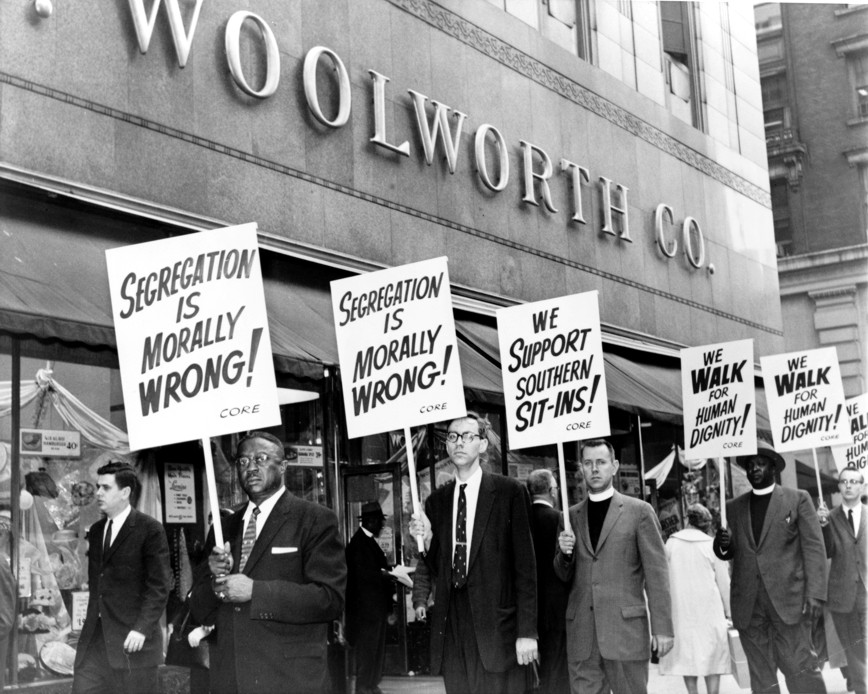
People are now marching on the streets across the country – and it’s calling attention to racism in America but it’s time for HR to march into boardrooms. It’s time for HR to lead the discussion on racism at work, not as means for attaining a certificate of completion for diversity training but with a goal of creating a culture and all the necessary elements to root out racism in the workplace. It’s time for HR to look its recruiting and retention practices to see if we’re “bringing” racism into the workplace with bad hiring and “promoting” racism with bad management.
If all this talk about racism makes you uncomfortable to think or speak about, think of your “valued” employees who endure these racially-charged emails, water cooler jokes, and I-know-why-you’re-here smirks because you failed to create a culture that supports the value they bring to your company. If your talent chooses to leave or you can’t attract the best and the brightest because your company’s HR policies, procedures, and people aren’t fair and supportive, do you know what that makes you?
As a Boomer I shouldn’t admit this, but I like reading The Daily Muse and the Savvy Intern. While this admission is likely to cause of few of my more opinionated folks to publicly guffaw, no worries – I’m a recruiter and my skin is thick.
But when I read The Muse’s post on 30 Things You Should Never Say in a Job Interview, the experienced recruiter in me cringed a thousand deaths at the apocryphal wisdom conveyed by the article. This isn’t to say there aren’t elements of truth in the points made by The Muse and the people they interviewed to glean the pearls of wisdom – it’s just that the underlying interviewing strategy employed by most recruiters and hiring managers is downright wrong. It’s the weakness of the strategy that has produced such bad job search advice.
Most recruiters and hiring managers interview to exclude rather than to include. Do they realize how much talent is not being brought to companies because of this flaw?
It takes extraordinary interviewing skill to be able to look for reasons to include someone in the next step; when the work load piles up, hiring managers start complaining about “no flow”; inexperienced or harried recruiters then begin to take shortcuts to cull the herd.
I can certainly understand – yet not agree with – this approach. It’s based on three flawed premises:
The resume is an accurate depiction of the person;
The candidate is an expert at interviewing;
The recruiter and hiring manager are experts at interviewing (and of course, know little things like marketplace salaries and the quality of the company’s employment brand).
Many of the very best people I’ve hired had résumés so bad that even the most junior career advising expert would have made the four-year-old-eating-broccoli-for-the-first-time sourpuss face when reading.
Ask any recruiter to honestly answer this question: In your entire recruiting life, how many of the people that you have interviewed would you truly consider to be experts at the craft? How many were average – or worse?
Then there are the hiring managers who take the “I’ll know it when I see it – so keep sending me more résumés” approach. My response to them has always been, “If you can’t describe it to me, how will you know it when you see it?”
Do you really believe that most involved in the talent acquisition assessment process know what they’re doing? I don’t – and I’m in the business! I’ll even bet that the ones reading this post are wondering if they’re an excluder or an includer. Good – introspection is good for their soul and their employer.
The crux of the The Muse article is that the result of the interview is all up to the jobseeker; this couldn’t be further from the truth. If I look at the core logic behind their 30 Things, I’m offering you this thought:
Most interviewers assess you on traits, characteristics, and quirks that play into well-developed biases and old wives (and husband) tales about work and performance, and far more often than they realize, mimic the traits, characteristics, and quirks of the people they work with – and actually get along with.
Things like school, gender, body type, job title, and current employer are all used to shade the person to the point where it’s “easier” to make a go/no go decision on everything except performance.
Why? Because true assessment of past performance and future performance potential is really hard and takes a great deal of time – something few actually have (or believe they have). There’s a tried-and-true recruiting metric called Time-to-Hire (AKA Time-to-Fill) and recruiter performance is partially assessed on this: Who has time to interview to include when their compensation is partially based on “time” metrics?
In other words, these talent acquisition “rockstars” are taking the easy way out and shoveling a big load of crap.
So while The Muse’s 30 Points of Fright do a fine job of highlighting to the jobseeker the fluffier elements that inexperienced recruiters and hiring manager can latch onto to make “excluding decisions”, frankly these pale in comparison to discerning about performance. While it’s human nature to focus on like/dislike when relationships didn’t work, deep analysis almost always reveals that one or both of the people didn’t perform. Snicker away.
Here it is straight from the an experienced recruiter who has learned that since talent rarely behaves the way you expect them to, you have to poke, prod, and pry if you want to make the very best hiring decisions: You have to actively search for reasons to include someone past the first step of the interview process, lest you passively exclude them for reasons other than performance.
The job title of your interviewer tells you nothing about the specific problems they’re tasked with addressing. N-O-T-H-I-N-G. When I’m asked about this, I actually think it’s a good question, an opportunity to explain the complexity of my special recruiting environment. Research will only tell someone so much – but if you want to slant the question a wee bit, ask me, “So, tell me about a problem that keeps you awake at night.” It’s still the same question.
“Ugh, my last company…”
“…was such a mess that it caused everyone to look elsewhere. Would you mind if we chat about how similar – or dissimilar this company is to my soon-to-be former employer?”
I know when you’re perfuming a pig and I guarantee that I will get you to talk about the hostile work environment because I know from experience how these things can impact performance. Do you really think you’re the only person to ever work for a Neanderthal? Do you really think that a just reward for 80 to 90 hour weeks is a proposition and an attempted good night tonsillectomy? Neither do really good recruiters or hiring managers. I prefer honesty to perfumed ungulates. “Ugh” doesn’t bother me one bit.
“I didn’t get along with my boss.”
Look, I’m going to call your former boss one way or another (relax, it won’t be until you join me). Might as well be upfront so we can discuss why. Do you really think you’re the only one who didn’t get along with their boss?
“I’m really nervous.”
If you only knew how many first time recruiters call me every week; in many cases I’ll let them prattle on for about one minute before interjecting with, “Can I ask you a personal question?” Their nervous reply, “Sure. Anything” (a typical response from inexperienced recruiters). My question: “What’s your name?”
Amy says “Fake it ’til you make it!” – I call this lying. If you tell an experienced interviewer that you’re nervous, they’ll calm you down so the interview can focus on the substantive content. The inexperienced recruiter and hiring manager will exclude you. They lose.
“I’ll do whatever.”
Frankly, if you’ve brought someone in for an interview and they say, “I’ll do whatever”, then it’s your ability to discern what that is. This happened to me a few days ago as I was writing this novella. Someone connected with me on LinkedIn and pretty much said, “I’ll do whatever.” Told her to check out Kaltura’s Career page and let me know which roles interested her – and why. I’m speaking with her in a few days. Your solution? Exclude. My solution? Mining a potential diamond-in-the-rough.
When an interviewer hears, “I don’t care what jobs you have available – I’ll do anything!” that’s a sign that another human being with some kind of talent is asking for help to focus. Interviewers might be quite surprised about the talent hiding behind “whatever.” But no – they have Time-to-Hire metrics chasing them around the office and it’s so much easier to shoo these people away.
“I know I don’t have much experience, but…”
Unless the recruiter or hiring manager is a psychic (not psychotic) and they fail to discuss problem-solving performance, hearing these words can only lead to the exclude conclusion if they’re interested in passing on potential talent.
Since you really don’t have much experience, I’m more interested in your words after the “but…” Telling me that you don’t have much experience is you being honest; the next step – the “but” is as much my responsibility as it is yours. I’ll help you while the inexperienced recruiter or hiring manager will exclude you.
“It’s on my resume.”
FYI inexperienced recruiters and hiring managers, “It’s on my résumé” is like saying something goofy on the first date. What do you do then? Do you say, “I’m sorry but I’ve allotted one goofy statement on every first date and you just made yours. Now take me home.”
Rather than getting a hair on their ass over nothing, the interviewer should smile and ask the person to explain. But exclude someone because of this? Fine. I’ll speak with them.
“Yes! I have a great answer for that!”
I enjoy candidates with enthusiasm and will go along with their energy – and then I’ll drill down. It’s the fault of job search experts for blurted out comments like this one by “prepping” them with answers to typical (read as pretty much useless) interview questions when their job should be to give jobseekers interview strategies (I almost guffawed as I wrote that); mine is extract the wheat from the chaff. Too many interviewers choose to exclude people with too much energy (some recruiters and hiring managers even believe that too much energy means the person has “emotional issues”) but I’ll keep the conversation moving. Bring on the energy – it’s better than another cup of coffee!
“Perfectionism is my greatest weakness.”
Me: “Then can you explain the algorithm you used to decide which accomplishments you ended with a period and which ones you didn’t?”
Candidate: [look of terror]
Me: “Think we can forget everything your career advisor, best friend or parents told you interviewing and start having a real conversation?”
Silly Interviewer: Exclude.
Me: Potentially hire.
“I’m the top salesperson at the company—and I have two semesters worth of Spanish.”
This is a combination of being nervous and receiving bad interviewing advice. I’d probably ask if they used their two semesters of Spanish in making a sale and watch them squirm a bit – then give them the chance to make again whatever statement they had in mind. Right now I’m thinking about how much I’d like to interview the experts quoted in this article to see how they’d do under pressure.
“I think outside the box.”
Do you know where people get these overused words and phrases from? Experts.
I’ve heard this one before and once responded with, “But we work in boxes here.”
Exclude? No. But instead of getting all eyerolly about it, the interviewer should ask what is meant by outside-the-box.”
“I, like, increased our social following, like, 25%…”
Fact: At some point during the interview, I will tell you how many times you’ve used “like”, “um” or “basically” – and simply suggest that it’s something you might want to work on decreasing. Not a big deal for the early careerist. Definitely not “exclude” worthy.
“On my third goose-hunting trip to Canada…”
Fine. If you ‘re interviewing at PETA, it might not make sense to talk about boar hunting. That faux pas is on the candidate.
I recently hired a sales executive who was especially chatty about his hunting. So we talked about it – and it led to a real substantive discussion about sales. Do you know why? Because he was comfortable with me because I didn’t go ballistic over things others might.
Folks – people are diverse, their experiences are diverse. Funny thing is that we categorize sales people into Hunter and Gatherer categories yet cringe when some make hunting or gathering references. Give holier-than-thou a rest, okay?
“I built a synergistic network of strategic alliances…”
If this emanates from your mouth during an interview with me, I will tilt my head like a Golden Retriever and say, “Huh?” then stare at you.
Problem solved.
“I pulled together the STF reports.”
Oh, you like “Office Space” too…
I hope that I’m lucky enough to one day hear this during an interview. Instant hire.
“Um, I don’t know.”
When I hear this, it’s my time to facilitate. Sorry Brainiac Job Search Advisor, but I’m going to ask your prized pupil WTF questions (you do know what this acronym stands for, don’t you?).
Instead of thinking, “Ah hah! Another one I can exclude!”, the interviewer should adopt the role of the creative talent scout they believe themselves to be and ask, “Okay, let’s work through this together” and jump start the conversation from “I don’t know” to “Okay, I really don’t have any experience in that area but here’s how I might solve that problem.” Hey – this might even lead to an include decision!
“How much vacation time do I get?”
We all know there are some greedy folks out there. The role of the interviewer is to differentiate between those who are greedy and those who are simply nervous. My suggestion to the interviewer is defuse with laughter or humor and find out why vacation is so important.
I’ve asked them if vacation time is more important to them than the work they’ll be performing; can’t recall someone ever saying it was. At least if they say, “Yep” I’d know for sure they’re not the person to hire.
“How soon do you promote employees?”
While it might not be the best way to ask it, someone asking this question is actually getting at an important element of an organization – the reward and recognition philosophy and policies of the company. Tolan’s way of asking is just another way of perfuming a pig. I’ll take the honest approach and answer it honestly. Others can exclude. Fine with me – I’ll just chat with you about your definition of performance.
“Nope—no questions.”
Me: “None whatsoever? Like what I ate for breakfast?”
You: “Really – no questions because this has been the most unique interview I ever had.”
Again, the recruiter has two choices: They can be snippy or they can ask the candidate once again if they have questions. I’ve found that the second time around dislodges the cobwebs of the interviewing and often leads to more talking.
Why so quick to kick someone out of the interview? Oh, it’s that Time-to-Hire thing again.
“Then, while I was at happy hour…”
Oh, I see the logic: It’s off-limits to discuss things like this during the interview but not once someone’s an employee and out with the gang after work for a night of festivities?
SMH. I think I’ll exclude the interviewer who gets upset over this.
“I’ll have the steak and a glass of Cabernet.”
It’s not the cost of the meal that concerns me but the complexity of it as it interferes with your ability to have a conversation.
Unfortunately, there are meal interviews where the interviewer will order something expensive just to see if you’ll order the same thing – then exclude you because you didn’t order on the cheap. These folks have rused you into exclusion.
My advice for candidates: Meal interviews are not for eating; order something small and easy.
“I’d like to start my own business as soon as possible.”
Since, most employers know that long term tenure means nothing but a pipe dream anymore, if you say this you’re giving me so much interviewing material to ask. Business plan, competitive landscape, strategies – all areas I can use to really get to know you.
I thank you for being entrepreneurial while my competitors exclude you for being ambitious.
“What the hell!”
I’ve said far worse. Even during my interviews. Sorry. Want to exclude me?
“So, yeah…”
So, yeah, we just had an incredible 30-minute back and forth about content marketing in the OVP space when you gave me an awkward pause.
OMG, should I exclude you because of this?
Please.
“Do you know when we’ll be finished here?”
Funny how many candidates believe that the length of the interview is proportional to likeability and hireability. Know the phrase, “If you gotta go, you gotta go”? There’s nothing wrong with telling me that time is tight because I can always schedule more time with you later – whereas others have already written you off. Fools.
“I’m going through a tough time right now.”
Not discussing important life events during the interview – or worse, being advised by experts that it’s a bad thing to do – is not giving me the parts of you that are likely impacting your interview performance. Interviews are pressure vessels in their own right; adding things like death or divorce (I know) can take an otherwise great person to places they’d rather not go.
At least with knowing I can discuss these things and ask you how much they’d be a distraction. I’ll look at your performances and your abilities to solve my problems. Then I’ll make my decision. Take a person who’s thinking “despair” and raise them up with some confidence and see how hard they’ll work. Be kind. Be human.
“Sorry I’m so late.”
Anyone ever get stuck for hours in the car or mass transit? Just call and let me know. Because you know, I’ve never been late for anything because I am an expert…
“Sorry I’m so early.”
I actually think early is good idea – to view the place as it happens. Many years ago I interviewed at a well-known company to possibly run their technical recruiting. Arrived early and noticed how the Receptionist would answer calls that were clearly from folks interested in working there. With her friends gabbing with her, this went on for 25 minutes, with each time the Receptionist making a disparaging comment about the person who called.
Leaders don’t have to be arrogant; I didn’t want to work there.
“Would you like to see my references?”
Me: “Yes I do.”
Gee that wasn’t too complicated, was it?
“I just wanted to follow up—again.”
“I know it looks like cyberstalking but in the recruiting world it’s called research” ~Me @SourceCon 2014
On some levels, pushy candidates are a bit like four-year olds:
“Why? Why? Why? Why?”
Yet we manage to get these lil’ tykes through to their next stage in life.
Geez, you’re interested. If the company isn’t, tell them – that’s the job of the recruiter or hiring manager. In many cases your’re pushy because the recruiter or hiring manager said they’d have an answer for them in two days – and it just hit the four-week mark. Once again, there’s that word for that.
It just boils my blood to read what passes as expert advice…
I got carried away with my comment and this morning realized it should be a post here on The Recruiting Inferno.
So read the post first, then the stuff below…
Fail No. 1: “I will find my next job by applying to a job online”
What this means is that after exhausting your ability to get to the hiring manager or recruiter via networking means, you really have to apply. Shoot, even a blind squirrel catches a nut from time to time (15%). Besides, many companies actually allow hiring managers to search the ATS – and if you’re not in there, you’re SOL.
Fail No. 2: “I expect to hear a response (either yes or no) soon after I apply”
If you receive an auto-response, please give it one week before you begin to barrage the company with calls, emails, text messages, and carrier pigeons.
This being said, I wish more companies were honest with feedback; it’s so simple. But you know why many don’t? Aside from the ones who are crappy recruiters, there are many jobseekers who simply won’t take “No, you’re not someone we’re going to hire because you have no experience doing the job – and no, despite being a fast learner, we don’t have 2 years to wait while you learn”; so many companies say nothing until the “Thank you for your interest” email is sent.
Fail No. 3: “My cover letter always will be read in full”
Think about this: If you hired someone to write you a professional resume which presumably explains “everything” and puts on you a demigod pedestal – why do you need a cover letter? To explain things not explained in the resume? Huh?
My order: Resume, online, LinkedIn (or equivalent), and maybe, just maybe, a cover letter.
Fail No. 4: “I’m networking…with people in Human Resources”
Unless you’re looking for a job in HR, no more than 25% of your networking efforts should be with HR folks. Do I really need to explain why?
Fail No. 5: “I can only network AFTER the job has been posted”
No one can manage your career better than you. Remember this advice after you land: Spend 2 nights EVERY month at a professional association endeavor.
What this means folks is that YOU ARE ALWAYS NETWORKING.
If you do, you just might be one of those who get the job before it gets posted anywhere. Joy.
Fail No. 6: “I’ll land an interview for every job I apply to”
Well – some people do. Some people got into every school to which they applied. Some folks are 4% body fat.
Most don’t and aren’t.
Fail No. 7: “My resume is the most important job search tool”
Your resume is one tool – one arrow in your quiver.
The best two tools are still the telephone and the handshake.
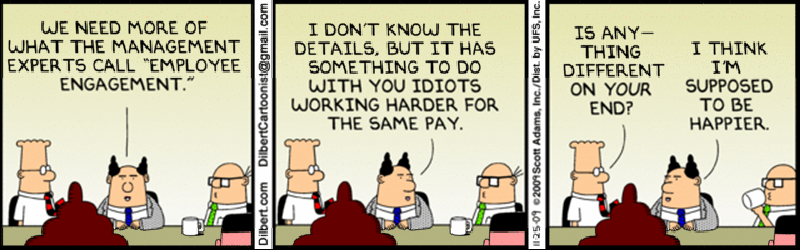
[thanks to Scott Adams for being so astute about HR issues & for the use of his intellectual property]
My thesis is that most have no idea what is meant by employee engagement:
That employee engagement isn’t something that company leaders can inspire just by being leaders.
That engagement is not an HR initiative that can be turned into talking points at a SHRM conference. Or an article on Forbes.
That when turned into an intellectualized topic for a weekly Twitter chat sounds phony.
That employee engagement is something that can only be inculcated into a company via better recruiting.
I won’t bore you with paragraph after paragraph by “experts” extolling the importance of engagement to company performance or how many rockstar leaders are quoted as saying the engagement is important. But let me go to the well just once with an article penned by Josh Bersin from Deloitte, “It’s Time To Rethink The ‘Employee Engagement’ Issue.”
Of all the articles I’ve read about employee engagement, Josh’s is the most thoughtful on the topic (which does not necessarily make it a great POV on EE) because it focuses on facts rather than feel-good fluff (or as I will from now on refer to as “pop HR”). At the end he wrote,
We can’t “retain” people, we can only “attract them.” We cant “engage them” but we can “inspire and support them.” We can’t only “train them” but we can “enable them to learn” and “give them the opportunities to develop.
Notice the first sentence?
Know what “attract them” means?
Recruiting.
Meaning if you wanted to – and knew how to – you could bring talent on board who already embrace engagement. No need to bring in external consultants to find out why people leave 10 minutes after their boss leaves; why even the crappiest external recruiters can get your employees interested in another crappy opportunity; or why you even have to worry about your culture.
Try engaging this:
You can’t engage employees who don’t want to be engaged; it’s not your leadership that’s broken, it’s your hiring. You waste so much time hiring for fit because it feels better – and feels more human – rather than spending the time defining what great performance is to the role, the group, the function, and to the company. It’s so much easier to let your supposed charismatic leaders do the work – or believe they’re doing the work – than improving your recruiting function, people and processes – which isn’t easy and takes time, effort, sweat and tears.
When you create a meal with subpar ingredients, you need lots of seasoning to make it taste better. And even then it might not taste great. That’s employee engagement. Why not simply start with better ingredients?
Far too much emphasis in business is placed on the role of the “leader” (quotes added because most all will say, “I’ll know a leader when I see one but I can’t tell you what that person looks like”) and far too little on personal leadership – you know, taking responsibility, doing what you said you were going to do, etc.
My parents worked very hard to teach me about personal responsibility – doing what I’ve committed to do and finding out ways to do what I’ve committed to do when things weren’t working out. We’re not born with an infallible responsibility gene but have to learn how to make things work – even when many of the “things” don’t want to work with you. Learning personal responsibility is a lifelong foray into the good, the bad, and the ugly of commitments, people and situations – and plenty of knees and elbows are skinned along the way. There’s no terminal degree or PhD in Employee Engagement; but our parents are the one’s who should have created the initial plan for building the road. You see, employee engagement isn’t a destination, it’s a journey.
And engagement sets the tone for culture – another completely misunderstood concept – where culture is what you do when no one is there to watch.
In the end, it’s worth it: Folks who learned about personal responsibility are likely those who don’t need external forces to be engaged – because they’re internally engaged.
You see these people at work all the time – but you call them brown-nosers, ass-kissers, and likely a few other phrases that even I won’t put in here. These people are just as likely to pat a leader on the back for something they’ve done to taking a peer aside and asking them why they simply refuse to answer a simple email.
These folks volunteer for tough assignments because they want to be the example for others to follow so the entire company can be successful. Yes, engaged employees are the ones who put the M & E into “t-e-a-m”. No need to be a hater.
Now guess what? You can recruit for people who are engaged.
Toss aside your tired and worn bar raising questions, and ask them about personal responsibility the way you ask about performance; ask about their parents (ask them if their parents actually made them spell out the word at the dinner table like mine did). Ask them questions about early childhood, teenage, college, and early career events and how they remember these events through the filter of personal responsibility; notice their facial expressions and their body language as they answer.
You’ll have to drill down far deeper than your great ESP skills will take you – but in the end, asking What does personal responsibility mean to you?will help you understand if the person is likely internally engaged.
After practicing this line of questioning over many candidate interviews (heck, try it out on your managers and peers too), you’ll be in a better position to determine if a person might be engaged only when there’s a gun pointed at their head (or a “leader” pointing at them while uttering words of exhortation and encouragement) or if a person has the engagement make-up because of what’s in their head.
But please read the line quoted above again and consider this: If we recruit people who are already engaged, that is, make employee engagement part of the recruiting process, we’re setting the table for a great meal.
There’s simply no science that a career and job search expert can refer to that can be used to guarantee that a recruiter will call you once your cover letter (if you’ve actually sent one) and résumé hits their Inbox. Even a spot-on performance match can’t get past the dumbass biases – or just plain dumbassability – that many recruiters and hiring managers carry with them to the office each day.
Where do people get their job search advice from? Do they even ask these experts if they actually know any recruiters? Or do they confuse “marketing gurus” with “talent scouts”? (Another reason for recruiting to never report to marketing)
Seriously:
To Whom It May Concern? Nothing says “lazy jobseeker” more than this salutation. Yeah, yeah, I know you’re going to ask me how does one identify the recruiter or hiring manager – and I’ll show you how freakin’ easy it is.
Dear Sir or Madame?Oh, this one is so much better – if you’re applying for a job at the Alien Area 51 Cathouse in Nevada (cut out the comments – I Googled “legal brothels in nevada”).
Dear Recruiting Professional?This one always makes be cringe. My – that last word is an awfully big assumption; might as well just use Dear Recruiting Rockstar.
Hi,? I seem to get this one quite a bit from overseas jobseekers. Makes me check to see if they have a first name. Yep – every time.
Dear Bob?My name is Steve. Douchebag.
What does get me to reply?
I know I’m different but as much as the five examples might turn many off and cause these turned off recruiting professionals to pass on a candidate, a very wise mentor long ago informed me of Weinberg’s Second Law of Computing and how it related to recruiting:
If builders built buildings the way programmers write programs, then the first woodpecker that came along would destroy civilization.~Gerald M. Weinberg
As it applies to recruiting, companies who “assess to exclude” rather than assess to include do more harm to their short and longer-term bottom line than any lying-on-their-résumé-weasel CEO could ever do. The only thing I can say for certain about any jobseeker with a perfect cover letter and résumé is that they have a perfect cover letter and résumé. I can’t determine their expertise or performance-ability from reading their collateral – only speaking with them can get me to this end.
Some of the best performers I know have résumés so bad that even career services consultants would puke a bit in their mouths ;).
This is why I don’t read the cover letters first: The battle against cover letter stupidity is still tough to overcome, even for this recruiting graybeard. So I wait. I’ll read the résume´; if this is promising, it’s off to the LinkedIn profile or some other secondary source. I’m looking for signs of gold rather than the presence of coal. In other words, I’m looking for performance, not just the presence of accomplishing tasks. Stuff that makes me think, “Dang, this person is special.” Tell me – what’s your special?
Finally, the cover letter.
And if it’s really, really bad, I’ll call. I just have to find out what compelled someone to write such a horrible job search tome (on a more philanthropic note, those who know me, know I make these calls to help jobseekers out).
Even if my name isn’t Bob…
On Monday, 10/27 at 10AM PT (1PM ET), I’ll be joining my friend Dawn Rasmussen on her Google+ Hangout, “Everything You Ever Wanted to Know From Recruiters… And Were Afraid to Ask.” No holds barred, no fluff. Just stuff you should be able to use to convince that recruiter or hiring manager to call you back. Here’s the link to the event.
Do you have a problem with how an organization publicly deals with an “issue”? Sure you do – with…
CEOs who lie on their résumés. Employees who steal. Coaches who sexually abuse their athletes. Running backs who teach love by leaving their 4-year old still bleeding after 6 hours after a lesson. Running backs who punch women.
Like most, you have a solution: Fire the CEO – because things will automatically improve. It’s a simple premise – since the fish stinks from the head, cut off the head and the fish will no longer stink.
Appears to me that leadership is no longer about true leadership but about what leadership should be as viewed by the most professionally trained members of society – members of the mainstream media (don’t worry – this won’t turn into a political bully pulpit).
Even athletes believe that the coach must go if the team is performing badly. Well that makes sense – rather than the team performing better, lop off the head and the body will magically go back to achieving greatness.
The problem with the lopping-off-the-head-of-the-stinking-fish approach is that it’s darn near impossible to graft on a new one that works with the body. Even more unfortunate, if you make a figurehead fire rather than working to identify the cancer and surgically removing it as well as modifying the mechanism that caused the cancer in the first place, little – if anything – really changes.
No, firing the CEO isn’t a cure – it’s vigilantism that feels good.
Many people want the CEOs in charge to go because they actually feel better about themselves when a person they perceive as being over compensated is fired. How many laypeople say, “I could do that job for that kind of money!”
No – you can’t.
What the armchair CEOs of the world don’t understand is that leadership isn’t an all or none quality. In fact, it’s only partially a quality. It requires experience in – and finding a delicate balance between – the financial, operational, legal, analytical, and organizational components of an organization. Sorry folks but Roger Goddell becoming Commissioner didn’t happen over night; in fact, it took 24 years. During his tenure, the league’s office has had to face many issues that were either new challenges to the league’s culture or issues that we actually part of the NFL’s culture for some time but were never properly addressed.
Walking on virgin ground and deciding what can be built upon it is a substantial part of the challenge of being a CEO and often leads to unpopular decisions by those who aren’t privy to all the reports and discussions. Behind these decisions we typically hear the impassioned opinions of those who are really just spectators calling for the beheading of the fish regardless of the facts.
However, one thing that is clear to me is that what comes to light in every sport with a public issue is that of the culture of the guiding organization. From this comes one simple question:
Where was HR?
Take PEDs – these are part of the culture in many professional and Olympic sports. Suspensions have been handed out, athletes have been vilified, and new organizations have been created to “address” the problems (practically a cottage industry).
Take coaches who take advantage of younger athletes, committing heinous crimes against the youth they’re being paid to develop. Coaches have been jailed and/or banned, lots of new policies have been created. Plenty of “we’ll solve the problem” from the sports’ organization leadership. Some of these leaders have even resigned.
Take players in a violent sport who commit violent acts in their private lives.
Culture. Culture. Culture.
HR wants that coveted seat at the table when times are good – but seemingly not when times are bad. Smiling on the day after the Super Bowl the NFL talks about how much money they made but being nowhere to be found when the player-assaulting-women videos are being played leads me to the simple conclusion that firing the CEO won’t improve at all the decades-in-development culture if the head of HR of the NFL isn’t the one responsible for fixing the problem.
New Orleans Saints offensive tackle Zach Strief, who serves as the Saints’ union rep, doesn’t believe Roger Goodell should lose his job but suggested that a season-long suspension would be a fitting punishment for Goodell since that’s what Goodell handed Saint’s head coach Sean Payton in the BountyGate situation.
Said Strief, “What is the precedent for making a colossal mistake? The precedent has been you missed a season. It’s very simple. The exact situation has already happened, and it happened here. There was a punishment and that was the punishment.”
Culture. Cohesiveness. Consistency.
If HR wants a seat-at-the-table when times are great, they have to be there when the shit hits the fan and sticks to it.








 The Recruiting Inferno