
The Recruiting Inferno

If you can't stand the fire at least appreciate the heat

  • This is Me

Are Companies Truly Ready for AI

Posted by Steve on June 17, 2025
Posted in: Recruiting. Tagged: AI, artificial-intelligence, business, Leadership, technology. Leave a comment

I just read Kyndryl‘s People Readiness Report 2025, a well designed survey and methodology that investigated company AI adoption.

Some interesting findings and thoughts to ponder:

AI Is Ubiquitous but Workforce Readiness Is Lagging. While 95% of organizations are using AI, 71% of leaders say their workforce is not ready to leverage it. AI adoption might be high – via “executive fiat” but workforce capabilities and culture inculcation lag behind, creating major obstacles to success.

Workforce Resistance to AI Is Significant. 45% of CEOs report that employees are resistant or hostile to AI. Cultural adoption of AI is a major challenge requiring more progressive change management strategies. But at a significant cost.

Misalignment Between CEOs and Tech Leaders. 73% of CTOs/CIOs believe employees are embracing AI but only 45% of CEOs agree. If not aligned, differing perspectives within leadership teams can stall progress. Read into this as you wish.

Only a Small Group of “AI Pacesetters” Have Fully Integrated AI. Just 14% of organizations (Pacesetters) have fully aligned their workforce, technology, and growth goals for AI. Few organizations have a holistic approach to AI and workforce integration – the obvious key for success. Wait – what do you think “fully aligned” means in human speak?

Skills Gaps and Uncertainty Are Major Challenges. 68% of CEOs vs. 45% of CTOs/CIOs see a lack of skilled talent as a significant barrier. Upskilling and reskilling are essential, but organizations are still unclear on how to address these gaps – while still retaining any semblance of “the human touch.”

AI Pacesetters Are Transforming Talent Management. 74% of AI pacesetters report having fully transformed their talent management processes (vs. only 25% of others). Emphasizing talent transformation is a differentiator for top performers. Of course, moving from “presentation mode” to actual “performance mode” at the organizational level is the challenge.

Trust Building and Change Management Are Critical. Only 42% of leaders are actively working to build trust in AI among employees. Lack of trust can stall adoption; organizations must involve employees, set clear ethical guidelines, and be transparent as to how performance will be measured to succeed.

If you’re in TA, TM, or HR, what might be the implications?

AI Readiness Lag. Companies that fail to upskill and enable their workforce for AI might struggle to attract top-shelf people who expect modern, AI-integrated workflows.

⚠️ Retention Risk: Employees will seek out employers who invest in their skills and keep them relevant in a fast-changing environment.

Workforce Resistance to AI. Perceived hostility towards or skepticism about AI within the workforce can tarnish a company’s employer brand.

⚠️ Retention Risk: Resistance can lead to frustration or disengagement, causing top talent to seek more forward-thinking, innovative environments.

Leadership Misalignment. The people you covet might perceive leadership dissonance as instability that can erode confidence in the company’s vision and create hesitance to join.

⚠️ Retention Risk: If employees sense mixed messages about AI, it can breed confusion and churn.

Small Number of AI Pacesetters. Companies not among the 14% of “Pacesetters” risk lagging in competitiveness both for AI-savvy talent and in business results.

⚠️ Retention Risk: Ambitious employees will migrate to organizations that prioritize and deliver on AI transformation.

Skills Gaps & Uncertainty. People are already wary of companies that can’t articulate how they’re bridging skills gaps and how these are tied to career development and total rewards. They’ll favor those with clear, transparent development paths.

⚠️ Retention Risk: Without continuous upskilling and clarity on AI’s impact, existing employees may leave for more future-ready workplaces.

Talent Management Transformation Among Pacesetters. Companies that aren’t transforming talent management risk being overshadowed by those who do especially since 74% of Pacesetters are already there. Of course, there’s a slippery slope here: An over-emphasis on “AI all the time.”

⚠️ Retention Risk: A static approach to talent management can erode engagement and career growth, pushing people out the door.

Lack of Trust-Building. With only 42% of leaders working on AI trust-building, most organizations are vulnerable to talent skepticism. Those being targeted as potential employees today ethical AI and transparency.

⚠️ Retention Risk: Employees who don’t trust the company’s AI use or feel it’s used against them will disengage and may exit quickly.

Well, what does this mean to us in the people business?

We need to move into full-on advisory and advocacy mode.

AI ignorance isn’t a strategy for success – but being a true People Advisor in the AI Era means you must be more educated about the SWOTs of the technology and how these are viewed by those you have in your organization and those you want. Take a course. Follow the leaders. Demand answers from vendors.

Don’t see a plan that includes how AI technologies will impact both internally-facing and externally-facing HR, TA, or TM in both the short and longer term?

Create one. Poll employees, job seekers, and customers and incorporate their POVs into it. Take a look at Edelman‘s fantastic Trust Barometer work and work these findings into your plan. Listen to both people’s excitement and trepidation and address these in all you people activities.

Advisory and Advocacy aren’t easy – they can potentially put you at odds with company executives who might have, at best, a cursory sense of how strategies impact people. Blustering aside, for most this isn’t one of their strengths…

But if not you then who?

Share the Inferno's Fire...

  • Click to share on X (Opens in new window) X
  • Click to share on LinkedIn (Opens in new window) LinkedIn
  • Click to share on Facebook (Opens in new window) Facebook
  • Click to share on Pocket (Opens in new window) Pocket
  • Click to share on Reddit (Opens in new window) Reddit
  • Click to email a link to a friend (Opens in new window) Email
  • Click to print (Opens in new window) Print
  • More
  • Click to share on Pinterest (Opens in new window) Pinterest
  • Click to share on Tumblr (Opens in new window) Tumblr
Like Loading...

Talent Acquisition Metrics That Actually Make Sense

Posted by Steve on June 17, 2025
Posted in: Recruiting. Tagged: AI, artificial-intelligence, Ethics, Leadership, metrics, talent-acquisition, technology. Leave a comment

What if the metrics we held near and dear to our Talent Acquisition hearts weren’t the best ways to measure the health and wellness of our hiring initiatives?

What if, as a Talent Advisor, you’ve been tasked with identifying new metrics to offer better insights into your workflows and performances?

Not metrics rolled up into a big mass that is devoid of true actionable insight but metrics that candidate experience, recruiter effectiveness, hiring manager partnership, and executive expectations.

Legend:
🟠 Candidate-Centric Metrics
🟡 Recruiter-Centric Metrics
🔴 Hiring Manager-Centric Metrics
🔵 C-Level / Strategic Metrics

The Metrics…

Time in Status Variance (TISV) 🟠 🟡 🔴
Measures how long people stay in each stage of the hiring process (e.g., sourcing, engagement/application review, interview scheduling), and highlights outliers.
+ People: Reduces ghosting and bottlenecks.
+ Recruiter: Helps identify where they’re slowed down.
+ Hiring Manager: Pinpoints where feedback or decisions lag.
+ C-Level: Reveals process inefficiency and its downstream impact on time to hire.

Net Hiring Experience Score (NHX) 🟠 🟡 🔴 🔵
NPS-style score that blends person, recruiter, and hiring manager feedback after each hiring cycle.
+ All: Holistically reflects satisfaction across all user groups.
+ All: Helps build a culture of accountability and partnership in hiring.

Feedback Loop Closure Rate 🟠 🟡 🔴
Measures the percentage of people (especially post-interview) who receive meaningful feedback, and how fast it’s delivered.
+ People: Directly improves experience and employer brand.
+ Recruiter: Encourages ownership of people journey.
+ Hiring Manager: Reflects commitment to communication.
+ C-Level: Brand equity and values

Interview-to-Decision Velocity 🔴
Tracks time from final interview to offer decision.
+ People: Reduces anxiety, keeps engagement high.
+ Recruiter: Identifies slowdowns in decision-making.
+ Hiring Manager: Encourages prompt evaluation.
+ C-Level: Prevents offer declines due to delays.

Internal Mobility Friction Index 🔴
Measures how often internal employees apply, progress, and are selected versus dropping out early.
+ People: Encourages growth within.
+ Recruiter: Promotes fair, internal-first hiring.
+ Hiring Manager: Highlights openness to internal talent.
+ C-Level: Signals talent retention and cost avoidance.

Recruiter Role Complexity Load (RRCL) 🟡
Weights recruiter requisitions not by volume but by complexity (seniority, scarcity, location, niche skill).
+ People: Reduces burnout, improves communication.
+ Recruiter: Encourages equitable req distribution.
+ Hiring Manager: Helps manage expectations on timelines.
+ C-Level: Aligns headcount strategy with capacity.

Hiring Forecast Accuracy (HFA) 🔵
Compares predicted versus actual hiring outcomes (timing, volume, quality).
+ People: Reduces last-minute changes and cancellations.
+ Recruiter: Promotes proactive planning.
+ Hiring Manager: Builds trust in TA predictability.
+ C-Level: Links hiring plans to business planning reliability.

Requisition Approval to Launch Lag 🟡
Measures time between when a req is approved and when it’s posted.
+ People: Shortens access to opportunities.
+ Recruiter: Highlights systemic delays or bottlenecks.
+ Hiring Manager: Drives urgency and alignment.
+ C-Level: Impacts “revenue or science”-critical headcount plans.

Candidate Sentiment Delta (CSD) 🟠
Compares people sentiment before and after interviews (via short pulse surveys).
+ People: Ensures the process improves perception.
+ Recruiter: Reveals breakdowns in communication or tone.
+ Hiring Manager: Correlates interview quality with engagement.
+ C-Level: Leading indicator of reputation and employer brand.

Offer Drop-Off Signal Index 🟠
Uses signals (delays, counteroffers, communication gaps) to predict risk of offer rejection or ghosting.
+ People: Enables preemptive re-engagement.
+ Recruiter: Improves offer-to-accept ratio.
+ Hiring Manager: Protects time investment.
+ C-Level: Reduces recruiting efficiency ratio and churn.

Hiring Manager Touchpoint Index 🔴
Measures how often and how meaningfully hiring managers engage in the hiring process (intake/discovery, engagement strategy, screening, feedback, interview participation).
+ People: Improves perception of manager involvement.
+ Recruiter: Reduces process drag.
+ Hiring Manager: Encourages ownership of talent outcomes.
+ C-Level: Culture of accountability and leadership quality.

AI Augmentation Ratio 🟡 🔵
Proportion of sourcing, screening, and scheduling tasks automated or AI-assisted versus human effort.
+ People: Faster responses, less delay.
+ Recruiter: Improves strategic focus.
+ Hiring Manager: Shorter time to slate.
+ C-Level: Talent cost efficiency and innovation maturity.

Talent Scarcity Exposure Score 🔵
An index that combines role criticality, geographic constraints, compensation competitiveness, and talent market saturation.
+ People: Better-informed expectations.
+ Recruiter: Supports smarter sourcing prioritization.
+ Hiring Manager: Sets realistic expectations.
+ C-Level: Talent planning for business risk mitigation.

First-Year Success Alignment 🔵
Tracks if new hires meet performance goals aligned to hiring criteria within their first year (no, this is not QoH; it’s objective rather than subjective).
+ People: Encourages onboarding and integration.
+ Recruiter: Links selection quality to outcome.
+ Hiring Manager: Measures hiring fit beyond “time to fill.”
+ C-Level: Business impact of hiring decisions.

Experience Consistency Index 🟠 🔵
Measures variation in experience scores across different locations, functions, and demographic groups.
+ People: Ensures equitable process design.
+ Recruiter: Standardizes best practices.
+ Hiring Manager: Flags inconsistent behavior or support.
+ C-Level: Equity, inclusion, and brand consistency.

Are any of these good? Bad? Meh?

I’m really interested in what you think.

~Steve

Share the Inferno's Fire...

  • Click to share on X (Opens in new window) X
  • Click to share on LinkedIn (Opens in new window) LinkedIn
  • Click to share on Facebook (Opens in new window) Facebook
  • Click to share on Pocket (Opens in new window) Pocket
  • Click to share on Reddit (Opens in new window) Reddit
  • Click to email a link to a friend (Opens in new window) Email
  • Click to print (Opens in new window) Print
  • More
  • Click to share on Pinterest (Opens in new window) Pinterest
  • Click to share on Tumblr (Opens in new window) Tumblr
Like Loading...

The Talent Acquisition Ethicist

Posted by Steve on June 17, 2025
Posted in: Recruiting. Tagged: AI, artificial-intelligence, Ethics, talent-acquisition, technology. Leave a comment

This Talent Acquisition post was inspired by Adam Gordon‘s post in Hung Lee‘s Recruiting Brainfood group on FB about The Adecco Group‘s announcement of a new company to integrate human and digital talent.

Yes, it was very odd typing “digital talent” – yet here we are in the light of the AI Era of Talent.

As we were bantering back and forth on the topic, it dawned on me: In the world of talent, we don’t have any formal role containing the word, “Ethicist.”

  • Medical & Bioethics has Medical Ethicist, Clinical Ethicist, Bioethicist, Hospital Ethicist
  • Technology & AI has AI Ethicist, Data Ethics Officer, Responsible AI Lead, Algorithmic Fairness Researcher
  • Government & Policy has Ethics Officer, Government Ethicist, Policy Ethicist
  • Scientific Research & Academia has Research Ethicist, Academic Ethicist, Institutional Review Board Member
  • Corporate has Corporate Ethicist, Chief Ethics Officer, Ethics and Compliance Officer
  • Environmental & Global Justice has Environmental Ethicist, Humanitarian Ethicist, Climate Justice Consultant
  • Journalism, Media, & Communications has Media Ethicist, Journalism Ethics Advisor

With the assistance of ChatGPT and reading a bit more about Medical Ethics, AI Ethics, and Talent Enablement, here is a proposed Job Description for a Talent Acquisition Ethicist, along with the roles scorecard and assessment rubric. I’m sure you can easily see how this role can be expanded into a much larger “Talent Ethicist” focus.

Yes, it needs work but I’m very interested in what you think about it.

Comments please!

Talent Acquisition Ethicist

Reports to: Head of Talent Acquisition

✳️ Role Summary

As our company scales the use of AI and data-driven decision-making across the hiring lifecycle, we are establishing a new and essential role – Talent Acquisition Ethicist. This role is responsible for ensuring that while our TA function evolves technologically, it never loses its human core. Drawing from principles in AI and medical ethics, the TA Ethicist will act as both a strategic enabler and moral compass, shaping how our tools, systems, and people work together to hire inclusively, transparently, and responsibly. 

You will lead initiatives that embed ethical thinking into our talent systems, design operational frameworks for equitable AI use, and ensure that every candidate experience – human or machine-mediated – honors fairness, dignity, and psychological safety. This role blends deep thinking, often new thinking, with real-world application and is ideal for someone passionate about shaping the future of hiring in a way that is both high-tech and high-touch.

✳️ The Core

⛛ Ethical Risk Governance & Framework Design

  • Lead ethical audits of all AI-driven and automated talent acquisition platforms, including sourcing algorithms, résumé parsers, and candidate scoring tools.
  • Develop TA-specific ethical frameworks and risk mitigation protocols in alignment with corporate values, international labor standards, and local regulations (e.g., EU AI Act, NYC AEDT Law, GDPR).
  • Evaluate third-party vendors and internal tools for ethical integrity, focusing on bias detection, transparency, candidate agency, and data protection.
  • Partner with Legal, DEI, and People Analytics to build an ethical governance roadmap for TA operations.

⛛ Human-Centered Technology Deployment

  • Act as a decision-making partner in the adoption, customization, and rollout of new AI-powered TA tools – ensuring enhancements empower, rather than displace, recruiter judgment and human connection.
  • Define “human-in-the-loop” criteria for systems that automate screening, ranking, or rejection workflows.
  • Lead the creation of ethical use policies for tools such as automated interviews, generative AI assistants, and chatbots.

⛛ Candidate Experience & Psychological Safety

  • Design safeguards to ensure informed consent, transparency, and fairness when candidates interact with AI or automated decision-making systems.
  • Monitor and enhance candidate sentiment metrics related to fairness, empathy, and perceived agency.
  • Collaborate with Employer Branding to ensure public-facing narratives about hiring tech align with ethical practices. 

⛛ Enablement, Training & Cultural Integration

  • Develop ethical literacy training programs for recruiters, sourcers, branders, coordinators, and TA leadership – covering bias mitigation, responsible prompt design, inclusive automation, and ethical AI use.
  • Contribute ethical guidance to recruiter onboarding and continuous learning programs.
  • Serve as an internal advisor to the TA Enablement team in designing scalable, values-aligned hiring processes.

⛛ Metrics, Policy & Compliance

  • Define and track key ethical performance indicators (e.g., fairness audit scores, candidate opt-out rates, bias remediation cycles).
  • Maintain documentation and policy standards for the responsible use of AI in hiring.
  • Respond to and prepare for emerging AI regulations and industry-wide ethical hiring benchmarks.

⛛ Thought Leadership & Stakeholder Influence

  • Represent Talent Acquisition in cross-functional ethics councils, responsible AI working groups, and executive-level conversations on digital transformation.
  • Develop internal guidance papers and best practice documentation for ethical recruiting.
  • Stay abreast of trends and research across AI ethics, labor market equity, digital privacy, and the future of work.

✳️ Core Success Metrics

  • % of tools or vendors that pass ethical review and audit process.
  • Completion and sentiment scores from recruiter ethics training.
  • Candidate NPS and fairness sentiment post-AI interaction.
  • Resolution rate and speed for flagged ethical concerns or system escalations.
  • TA process changes implemented based on ethical findings.
  • Compliance readiness for external audits or new legislation. 

✳️ Core Qualifications

  • 12+ years of experience in Talent Acquisition, TA Operations, People Analytics, HR Tech, or related fields.
  • 5+ years of experience in a high-level leadership capacity in any Talent function.
  • Demonstrated understanding of AI/ML applications in hiring workflows.
  • Strong grasp of ethical theory (e.g., fairness, transparency, autonomy, beneficence) and practical application.
  • Experience conducting impact assessments or governance projects.
  • Exceptional written and verbal communication skills, particularly when translating complex ideas across technical and non-technical stakeholders.

✳️ Preferred Qualifications

  • Graduate-level education in Ethics, Philosophy, Organizational Psychology, HR Technology, or Data Science.
  • Background in AI ethics, medical ethics, or compliance frameworks.
  • Familiarity with ethical sourcing and inclusive design.
  • Certifications in Responsible AI, DEI strategy, and/or HR data privacy.
  • Experience working with global, multi-jurisdictional teams spanning “mail room” to “Board room”.

✳️ The Ideal Person Is…

  • A principled systems thinker with the operational savvy and emotional intelligence to drive change.
  • Committed to designing fair and inclusive hiring experiences at scale.
  • Skilled at pushing back against over-automation and caustic people strategies, policies, and processes, while enabling innovation.
  • Comfortable navigating ambiguity in a fast-paced, tech-enabled environment.
  • Equal parts philosopher, policymaker, and talent operations strategist.
  • Adept at embracing the “Tow ears, one mouth” Proportionality Rule. 

✳️ Talent Acquisition Ethicist – Role Scorecard

Mission: Ensure that our AI-enabled talent acquisition systems are ethically sound, transparent, and human-centered.

Outcomes: Operational ethical frameworks in place, measurable bias reduction in AI-assisted tools, high candidate satisfaction with transparency.

Competencies: Ethical risk assessment, TA tech enablement, cross-functional collaboration, regulatory alignment, change leadership.

Culture Fit: Empathetic, integrity-driven, systems thinker, educator, challenger of status quo.

✳️ Performance Rubric – Talent Acquisition Ethicist 

⛛ Ethical Governance & Risk Assessment

Minimal: Fails to identify or assess ethical risks in tools or processes.

Basic: Recognizes major risks but lacks proactive assessments or remediation planning.

Strong: Conducts thorough impact assessments and integrates ethical checkpoints into vendor/tech reviews.

Superb: Proactively leads organizational AI ethics governance; anticipates ethical dilemmas before they arise.

⛛ Human-Centered Design of TA Workflows

Minimal: Automates without consideration of candidate experience or psychological safety.

Basic: Makes some efforts to preserve human touchpoints, but inconsistently.

Strong: Builds intentional workflows balancing tech efficiency and human judgment.

Superb: Designs model TA experiences where empathy and automation coexist seamlessly.

⛛ Training & Ethical Literacy

Minimal: Provides no ethical guidance or enablement.

Basic: Conducts occasional ad hoc training sessions.

Strong: Implements consistent training with relevant case studies and adoption metrics.

Superb: Creates a learning culture where ethical hiring is core to TA identity.

⛛ Stakeholder Influence & Leadership

Minimal: Rarely consulted on tech or policy decisions; lacks influence.

Basic: Participates in discussions but struggles to drive outcomes.

Strong: Respected advisor and frequent contributor to strategic decisions.

Superb: Trusted ethics leader shaping policy, product direction, and cultural norms across TA.

Share the Inferno's Fire...

  • Click to share on X (Opens in new window) X
  • Click to share on LinkedIn (Opens in new window) LinkedIn
  • Click to share on Facebook (Opens in new window) Facebook
  • Click to share on Pocket (Opens in new window) Pocket
  • Click to share on Reddit (Opens in new window) Reddit
  • Click to email a link to a friend (Opens in new window) Email
  • Click to print (Opens in new window) Print
  • More
  • Click to share on Pinterest (Opens in new window) Pinterest
  • Click to share on Tumblr (Opens in new window) Tumblr
Like Loading...

My Name Is Not “Candidate”

Posted by Steve on October 24, 2016
Posted in: Humans, Job Search, Recruiting, RecruitingDaily. 2 Comments

[In a collaborative co-writing effort originally appearing on RecruitingDaily, Derek Zeller and I took turns writing paragraphs. If you want to learn more about either of us, use google, bing, etc.. That’s your job after all.]


My first name is not passive; it’s not Talent. My Mom never gave birth to a child named Candidate; my Dad never told his friends, “This is my son, Human Capital.”

My Name Is…

My name is Monica, and I am frightened. I am a single mother trying to raise a family and protect them.  I am diligent, trustworthy, and I will make a company better.  My name is Monica, and all I ask is a chance, an opportunity to at least talk with you for just a moment, all I want is an opportunity to prove myself.  My name is Monica, I don’t want a handout.  I want to work to provide for my family, feed my children, and pay my rent.  Please take a chance on me, I promise you will not be disappointed Please? My name is Monica, and I am scared. Why?

My Name Is…

My name is Emory, and I am angry. After working for the same damn company for 36 years and consistently receiving great reviews and raises, all of a sudden my job gets outsourced to some third world country and I’m not even given a chance to interview for another internal job?  What we’re going in a different direction is the BS line the consultant tried to feed me; HR didn’t even have the guts to tell me this to my face. What am I supposed to do now? Drive for Uber? How am I going to pay for my kids’ college tuitions? Who’s going to hire someone who isn’t an anointed Millennial with skills that are “up to date”? Hell, when did using a smartphone app become more important than being able to build a smartphone? What’s wrong with these people? Don’t they know that they’re destroying our country? Why I wasn’t even asked to stay? Why?

My Name Is…

My name is Carl, and I am tired.  I am over 40 in Silicon Valley and I am sick of hearing that I am not a culture fit for your company. I am over qualified for the position. Since when did actually having the skills to do what is required to get that project done be a bad thing?  Why are all the startups ignoring me, blatantly telling me that I am too old? I have shaved off my beard, dyed my hair, I’ve been there and done that and got the requisite t-shirt.  Why do you have a team trying to accomplish a project I could do alone and before the deadline? The reason you are going under is that you are hiring friends and pretty people instead of those who know how to get the job done. You choose to fail without me instead of succeeding with me. Why?

My Name Is…

My name is Samantha, and I am so confused. Everything I’ve always wanted to achieve I have. While I was in school, I took some of the hardest courses. I volunteered in my community. I tutored high school girls. I have a high GPA. And all I can get is a job as a Receptionist while living with three other girls in Brooklyn? Look, I know we’ve been called the entitled generation but when did wanting to make a difference in the world come to mean entitled to a job that has nothing to do with your major and falling further and further behind on your bills? Why don’t you just ask me to help you and your company to be better? You’re not that much older than me yet you already know that I won’t be able to do the job? Why are you so afraid to take a chance on me? Why?

My Name Is…

My name is Hector and I am lost in understanding.  At eighteen, I joined the US Marines because I could not afford college and I wanted to serve my country and I am proud that I did. I fought in two wars. I took a bullet for this Nation only to come home to nothing. To be forgotten.  I am told that I could pose a possible disturbance due to PTSD, which I don’t have. I can not get a position anywhere, not even Walmart as a stocker. I carried out logistical missions, drove million dollar machinery and led men into battle when I had to. Yet here I am, one month away from being homeless because I cannot afford rent. My savings are almost gone, and all I find is stone hearted people that callously never return my calls or emails after they first talk to me. Why?

Our Names Are…

Our names are Derek and Steve, and we don’t know what to say to these people.  They are people you know – those resumes you’re holding. Not sure when we forgot that but we’re still left speechless by the outcome. These resumes aren’t the whole story for people who have names and lives – stories to tell and experiences that could change your company. 

Many years ago, we began our journey into this profession and have helped so many people get something better.  There have been struggles, sure, many whom we could not help or those we didn’t want to due to arrogance. Yet what is worse is the lack of support we receive from the bulk of those in our recruiting community.

Far too many recruiters don’t practice the listening skills they’re seeking and make too many assumptions regarding what they believe you want to do, what they believe will make you happy. Far too many recruiters – seasoned and non-seasoned alike – believe they have ESP and are experienced psychotherapists. Damned what you say during a screen or an interview, they’ve already made up their feeble minds.

Too many recruiters practice the “fake it until you make it” training model, and actually believe they’re skilled enough to assess people’s functional and technical skills. Many won’t even admit they don’t know what they don’t know.

Feedback. None. They will even tell boldface lies to your face.

Lying, faking, and silence might be major pillars of a tawdry drama–romance–crime novel but in our profession, these three elements lead to only one thing:

Hate

Share the Inferno's Fire...

  • Click to share on X (Opens in new window) X
  • Click to share on LinkedIn (Opens in new window) LinkedIn
  • Click to share on Facebook (Opens in new window) Facebook
  • Click to share on Pocket (Opens in new window) Pocket
  • Click to share on Reddit (Opens in new window) Reddit
  • Click to email a link to a friend (Opens in new window) Email
  • Click to print (Opens in new window) Print
  • More
  • Click to share on Pinterest (Opens in new window) Pinterest
  • Click to share on Tumblr (Opens in new window) Tumblr
Like Loading...

15 Septembers of Souls and Data

Posted by Steve on September 11, 2016
Posted in: 9-11, 9/11, History, Recruiting. Tagged: 9-11. 2 Comments

For 15 Septembers I have felt the angst in the days leading up to 9/11 and on the day, to wake up with tears that made the first steps out of bed difficult. I’ve been so fortunate to be allowed to spend each 9/11 at Squad 1 and get to know the firefighters and their families (today we talked about ink and gushed over each other’s tats); to be able to hear Metrotech’s announcements for when the Towers fell; to be at the Mass around the corner from the firehouse.

I’ve also seen the faces of spouses, siblings, relatives and parents of the departed grow weary and weathered with grief that I suspect will never go away. No one who lost someone can ever forget.

Last year, the Washington Post published a somewhat objective assessment on how many Americans actually remember 9/11. With each passing year, more Americans are born whose only understanding of the terrorist attacks will come via stories handed down by older friends and family, or taught in a social studies class (and this teaching comes before revisionist educators choose to change the details to be more inclusive of terrorists groups).

6247962678394880WaPo’s analysis showed that on 9/11/2015, 25.8% of the country was six years of age and younger (8%), or not yet born (17.8%). With approximately 4 million people being born each year and approximately 2.6 million dying each year, the percentage of people being born after 9/11 will rise every year, memories of others will change or fade, and the life stories of specific people will likely be blended together into an amorphous mass that is transformed into “an event in United States history.”

Just like the day the Japanese attacked Pearl Harbor on December 9, 1941, “a day which will live in infamy.” Except that only 6.2% of Americans still have a personal recollection of the event. Most Americans don’t know who uttered those infamous seven words. That 2,402 people were killed in the attacks. Or that one day later, the United States formerly entered World War II.

2,996 people were murdered on 9/11. Here in New York City, of the 2,753 people killed that day, only 1,638 people have been forensically identified. Do and math and ponder the significance of someone you love dying and literally disappearing forever.

And the cancerous dust will likely produce a higher number of deaths than the initial attacks…

According to the CDC and OSHA, as of July 2016, 1,064 rescue and recovery workers have died from diseases directly attributed the attack; there will be more. Even after the dust settled, 9/11 continued to be a witch’s brew of death. Compared to pre 9/11 data, FDNY cancer rates are 19% to 30% percent higher for firefighters who worked on the pile.

But remembering 9/11 is more than just big data; it’s about the people whose stories might never be truly known when the events of the day are distilled into history lessons…

My friend, fellow Jones Beach Lifeguard, NYC Firefighter with Squad 1, and rowing partner Dave Fontana was in the South Tower; my fellow Jones Beach Lifeguard Billy Burke – who always answered the telephone, “Lifeguards, Robert Moses State Park Field Three. William F. Burke, Junior speaking. How can I help you?” – was in the North Tower with his 21 Engine crew.

davestevemonkey9/11 was also Dave’s 8th wedding anniversary (I’ll do some math – today would have been his and Marian’s 23rd anniversary); they were to have celebrated their anniversary at the Central Park Boathouse and at the Whitney Museum. Some time around 9AM, he called his wife as he was finishing his 24 at Squad 1 and told her, “I’ll meet you in 10 minutes.” Then Hell on Earth began. Dave and his other Squad brothers were partially through the Brooklyn Battery Tunnel when traffic snarled; they ran the rest of the way to the Towers (that’s 60 pounds of gear).

Dave’s last known location was on the 45th Floor. His memorial service was held on October 17, 2001 – without a body. His body was found on December 8, 2001. There was another and far more private funeral shortly thereafter.

billyburkeBilly, the Captain of 21 Engine, was in the North Tower with his crew as the South Tower fell. His crew kept calling, “We got to get out, Cap.” His answer?

“You guys go ahead; we’ll meet at the rig.”

Billy disappeared to search another floor, while his crew made it out before the North Tower also collapsed. His body has never been found. How can I help? By giving up your life and saving the lives of others.

Ashes to ashes, dust to dust.

While history lessons about 9/11 will eventually be written with the insensitivity of numbers, 9/11 is really a lesson about souls lost and lives sent in unexpected directions. Whose stories will you tell? Will you know how Dave and Billy truly lived? How about my fellow Jones Beach lifeguards Christian Maltby and Tom Palazzo who worked at Cantor Fitzgerald? Will you care that they walked this planet and touched so many?

15 Septembers later and it still feels like a deep paper cut to the soul. But at least I’m here; I still have time to think and act in ways that would make Dave, Billy, Chris, and Tommy proud. So ask me about them, and I’ll sit with you for as long as wish.

I want to tell you their stories so 9/11 becomes an historical event about the lives and souls of remarkable people and not one of distilled data.

Share the Inferno's Fire...

  • Click to share on X (Opens in new window) X
  • Click to share on LinkedIn (Opens in new window) LinkedIn
  • Click to share on Facebook (Opens in new window) Facebook
  • Click to share on Pocket (Opens in new window) Pocket
  • Click to share on Reddit (Opens in new window) Reddit
  • Click to email a link to a friend (Opens in new window) Email
  • Click to print (Opens in new window) Print
  • More
  • Click to share on Pinterest (Opens in new window) Pinterest
  • Click to share on Tumblr (Opens in new window) Tumblr
Like Loading...

#Noise

Posted by Steve on July 6, 2016
Posted in: Recruiting, Social Media. 2 Comments

Noise

Authored and cross-posted with Pete Radloff and Derek Zeller

We didn’t turn it on, but we can’t turn it off, off, off
Sometimes I wonder how did we get here
It seems like all we ever hear is – Noise
~Kenny Chesney

Lately, there’s been a growing amount of anger, disillusionment, and Straight-Outta-Compton need for attention across the social galaxy. Lines being drawn, lines being crossed, lines being blurred and the silence or screams that have followed have been too easy to track – I mean, if you wanted to spend hours each day involved in this “social sleuthing”. Many of us looked at what was going on like the car wreck on the side of the road, slowing down to rubberneck at the carnage. Our collective minds have been overwhelmed by the Comments, with the unfounded accusations, and the downright malicious behavior.

Folks, the time is now for an industry-wide wake-up call. YES, we contribute to the stench just like everyone, but we try to provide something positive, something we see as having value. Whether others believe we do, or how this “value” is perceived, is going to be up to the reader’s interpretation.

Words are supremely powerful and when used poorly, can emotionally hurt even the most hardened of people. Here is the thing: it’s not necessary nor productive to let your Id run wild on social media when the Super Ego knows there are better ways to make your point. You are not a Captain of anything when seated by a computer espousing some drivel or spewing hatred. There’s no positive outcome for ever joining the Contagion Crew, taking sides, and verbally ganging up on others – just as there’s no reason for fomenting a fight because you get a rise out of watching people froth at the mouth.

Grow up!

There is a laundry room in your house or down the street. We, as in the majority of people online, are not interested in your laundry, dirty or clean. How many of you remember high school? We do, and while it wasn’t awful, it was full of things we were glad to leave behind. Backstabbing, cliques, and gossiping were part of many a social circle back then before there was anything as intimidating as social media. We all went our ways and thank goodness there weren’t going to be any more cool kids.

Except, apparently, there still are those that don’t agree.

HomerFacebookWe see it coming back, rearing its ugly head in the professional world, and to say it’s a shock to the system is an understatement. And it’s marked deviation from the drama back in the day.

Back then, if you had an issue with someone, the confrontation had to be handled face-to-face. If you needed to avoid the drama, hiding out in your house was an option. Most importantly, you weren’t sharing this spectacle with 1100 of your closest – cue hand air quotes – friends.

Social Media has decisively changed the game as it relates to how people handle drama in their personal and professional lives. When you lump in the fact that those two lines are blurred within these relationships that are created as a result of social media, it compounds things. Sadly, this type of relationship development is commonplace in recruiting.

Think of all the conferences that aren’t weird to go to now, because you’ve been interacting with ‘Sally’ who recruits for ACME for two years, and now you’re meeting at a {insert conference here} for the first time in real life. Many of us have developed the relationships that we have because we find commonality with colleagues on both levels. We suspect this is not unique to the recruiting industry, but hey, you write about what you know. What this means is that within our industry the family tree runs in both directions – often with less than pleasing results.

Handling your business with someone used to take some cojonés. Nowadays, it takes nothing to throw jabs through your WordPress site or to add a dash of snark to your posts on Facebook and Twitter. And because the Ego is a fickle fellow, many of these barbs will be served back and forth at breakneck speed and reckless abandon without regard for the people caught in the crossfire – which amounts to all of us bearing digital witness to this. Remember kids, what you say online stays online and as Levy espouses, will follow you to the grave.

For sure, there will be the clogging of News Feeds, and the endless string of comments on Facebook (especially since the posts will be strategically placed in groups where it will get eyeballs of varying temperaments, with responses ranging from meh to unbridled outrage). However beyond the digital shooting gallery, there are the conflicts between colleagues as humans and friends. Are people expected to choose to side with one person or the other? Are you on Team Sally or Team John? Aren’t these conundrums we left in the dust with Cavriccis and Scunciis? (sorry two of us grew up on Long Island, an Area-51-like testing ground for horrible fashion trends). We’re supposed to be older and wiser, or so the legends tell us. But yet, we as seasoned professionals are still mired in immature discourse. Heaven help us if there’s something about Social Media that inherently pushes our EQ back to our early teenage years…

We collectively struggle with the impetus for all of this (besides the ever-present Ego and it’s new social behavior known as humblebragging), and how it has become so pervasive. Don’t we all want to see each other succeed? Whether you are in on Team Recruiting, Team Branding, Team Content or Team HRTech, don’t we all stand to gain from the success of others in our industry? Even if you aren’t a fangirl of the work that person is doing, if it’s not inherently destructive to the profession, then live and let live. This goes out to the people who feel they need to “out” the haters, as well. Seriously folks we have enough people in the world who hate us – there’s no need to add to the already deafening noise.

Look, we all work 40-60 hours a week; many of us have families that include kids. Add in all the other peripheral daily nonsense, and it takes up a lot of our time. And we haven’t even included the amount of time spent at social recruiting events. Sometimes this is at a conference, and sometimes it’s just Wednesday. Where in the world do people find time to squeeze in extracurricular drama into their lives that eviscerates others? We shouldn’t have any spare time for this shit.

If you don’t believe that the vast majority of people in our field want to see all of us succeed, then maybe you need to check out #HROS – where sharing is caring is the message that is both preached and practiced.

ElieWiesel“Those who kept silent yesterday will remain silent tomorrow.” ― Elie Wiesel, Night
Elie Wiesel spent his adult life trying to understand how human beings could be so horrible towards other people. He died this past weekend at the age of 87.

Wiesel was a Holocaust survivor whose post-concentration camp raison d’être was talking about his experiences as a then 15-year-old. With his passing comes a very simple declarative statement: Someone – or many – needs to take his place in seeking to understand why humans treat other humans so poorly because for certain, we haven’t progressed as far as we should.

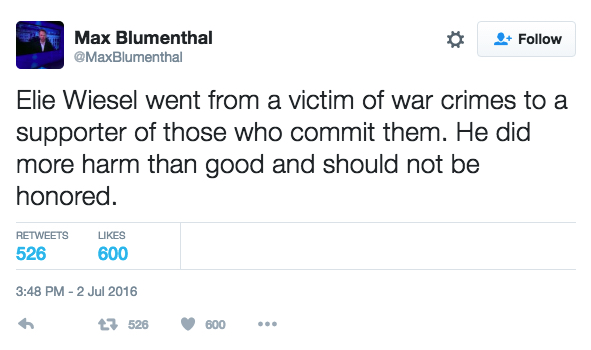
While social media has its benefits, in reality for most it merely serves as a bully pulpit to exacerbate the nastiness and the worst that human beings can throw at each other. Trolls used to be mythical creatures and fairy tales; now they are educated professionals whose purpose in life appears to be foisting misery on others. Case in point with anti-Semite Max Blumenthal taking to Twitter to demonize Elie Wiesel after his death:

Max Blumenthal on Elie Wiesel

People troll over grammar; they troll over spelling; they troll over politics; they troll over religion; they troll over gender; they troll over the skin color of a President; they troll over a profession. They troll, troll, troll under the darkness of open social media platforms – because the platform gives them the tools and the emboldened voice to do so. There are anti-bullying groups on Facebook that get bullied and human resources and recruiting professionals who out of one side of the mouth claim compassion and on the other hand spew vitriol.

We say it is time to STOP the #noise. We have been spoken to via IM, Twitter, the book of Face, hell even on LI, and it is madness. People are wounded, hurt, and ashamed that friends are doing this yet they are silent. We three are not, and believe us, we did not want to write this, but we felt that we had to.

What we are saying is take a moment to breathe.

Think of what you are saying and how you are saying it.

Remember the Carpenter’s Maxim of Measure Twice, Cut Once before posting to social platforms.

Words can do more damage to a person’s soul than any beating that could be laid down and the scars can last a lifetime. For all involved…

Share the Inferno's Fire...

  • Click to share on X (Opens in new window) X
  • Click to share on LinkedIn (Opens in new window) LinkedIn
  • Click to share on Facebook (Opens in new window) Facebook
  • Click to share on Pocket (Opens in new window) Pocket
  • Click to share on Reddit (Opens in new window) Reddit
  • Click to email a link to a friend (Opens in new window) Email
  • Click to print (Opens in new window) Print
  • More
  • Click to share on Pinterest (Opens in new window) Pinterest
  • Click to share on Tumblr (Opens in new window) Tumblr
Like Loading...

Artificially Stupid Recruiting

Posted by Steve on May 20, 2016
Posted in: Recruiting. Leave a comment

[originally published on ERE Media’s SourceCon site – link is at the end of this post]

robot-700x467Recruiting industry analyst Rob McIntosh believes “AI recruiting” is the future of recruiting. Ah, another future of recruiting article! Another tome in the latest assembly line of predictions that the profession will be elevated to the one where Supreme Bot Beings sit atop the Totem of Talent. Alas, being a human recruiter is no longer considered to be sexy enough for the Futurists.

Actually, automated recruiting isn’t what Rob is about, efficient recruiting is. We’ll get back to this notion in a few paragraphs.

It is very easy to be snookered in by the sweet smell of technology, unicorn valuations, 30 under 30 lists – and anything that comes to the masses via Google. But allow me to offer another perspective to this future of recruiting discussion.

Artificial Stupidity…

If there’s artificial intelligence, then by logic there has to be artificial stupidity – as in taking the Word of the Bot as Gospel. People, this is a very slippery slope that portends to push aside human expertise, experience, and compassion. Sure, the system can learn, the AlphaGo architecture is a unique extension of previous AI architectures (more about this soon), but humans have a funny way of turning logic on its side and playing a hunch that has a deeper, more robust meaning than any Monte Carlo tree search fueled by “…a huge amount of compute power” can make. Again, more about this later.

Just to be clear, I’m not against #BotRecruiting for the repeatable, scalable types of roles that take up so much of a Sourcer’s or Recruiter’s time, with or without pipelines and talent communities. Just the opposite, I’m very bullish on #AIrecruiting, addressing 68% of all hiring that isn’t significantly specialized (this is the plus or minus one standard deviation of all roles) based upon the range of problems to be solved when on the job.

I’m talking about large-scale hiring in, for instance, customer service, early career sales, retail, warehousing, even entry-level software development, where data is plenty, efficiency is a key goal, and humans are susceptible to injecting bias into the hiring process. I’m also bullish about an #AIrecruiting system that cultivates the digital crumbs and creates “probabilities of behavior” that can be used by human recruiters at some point in the process. We’re getting there tech-wise, but have a long way to move beyond black and white stones.

As promised earlier, one thing that Rob missed out on was describing AlphaGo’s architecture (it’s a darn good read), and why its performance is more evolved than previous attempts at building artificial intelligence solutions to games:

“…it combines a state-of-the-art tree search with two deep neural networks, each of which contains many layers with millions of neuron-like connections. One neural network, the “policy network”, predicts the next move, and is used to narrow the search to consider only the moves most likely to lead to a win. The other neural network, the “value network”, is then used to reduce the depth of the search tree — estimating the winner in each position in place of searching all the way to the end of the game.”

See what AlphaGo is doing with the parallel networks? Assessing hunches…feelings…ESP is what many recruiters call it. With experience, our hunches, fueled by many different scenarios and outcomes from the past, produce a higher probability of the likelihood of success, and with some hunches we learn that they don’t produce a desired outcome. Same with AlphaGo, as long as there’s more computing power to drive the parallel nature of the algorithm.

“Of course, all of this requires a huge amount of compute power, so we made extensive use of Google Cloud Platform, which enables researchers working on AI and Machine Learning to access elastic compute, storage and networking capacity on demand. In addition, new open source libraries for numerical computation using data flow graphs, such as TensorFlow, allow researchers to efficiently deploy the computation needed for deep learning algorithms across multiple CPUs or GPUs”

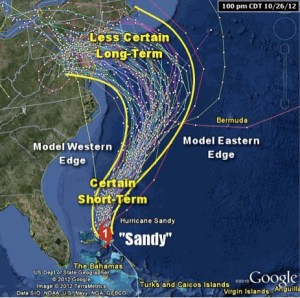
HurricaneSandyTrackingLet me put this another way: Remember the post-mortem analysis of meteorologists who had tried to predict the path of Hurricane Sandy? The picture below details all the models of possible paths based on a tremendous amount of data collected over decades. These models were created using a variety of simulations running on some of the most brutish computers on the planet. Yet we remember what happened, and the cost? Simulations and predictions are just that.

Each “Hurricane Sandy” adds more data and new sets of rules (learning) that enrich the model and change the hunches. Yet we all know that even the best model results in catastrophic damages. Sometimes the recruiting and hiring of the right person truly is a confluence of hunches, to an experienced recruiter, almost leaps of faith. This #AIrecruiting sure isn’t easy.

In 7 Trends for artificial intelligence in 2016: ‘Like 2015 on steroids’, Andrew Moore, Dean of Carnegie Mellon’s School of Computer Science notes:

“One thing I’m seeing among my own faculty is the realization that we, technologists, computer scientists, engineers who are building AI, have to appeal to someone else to create these programs. When coming up with a driverless car, for example, how does the car decide what to do when an animal comes into the road? When you write the code there’s the question: How much is an animal’s life worth next to a human’s life? Is one human life worth the lives of a billion domestic cats? A million? A thousand? I would hate to be the person writing that code.”

Consider the #AIrecruiting software developer, if they are an avowed animal lover, do they play a Death Race 2000 scenario in their head while coding? This is one of many issues with developing systems to replace or augment humans.

Open source, open stack, and APIs too often mask the fact that there are human beings on the other side of the application. Artificial intelligence, machine learning, intelligence systems, and automation so good that they’ll replace human beings, are not by themselves the seeds of success but are foods that when consumed unchecked further the divide between people and technology. The carrot that is held in front of us, that will have more time to do the things we love, isn’t necessarily reality. Just like the addictiveness of drugs, alcohol, and cigarettes, technology draw us in and not let go. Ask me how often I’m hiking on a lonesome trail only to come across people glued to their smartphones.

More data does not mean necessarily translate into better decisions when the human brain is conditioned to trust the technology rather than the brain.

Perfect marriages end in divorce: what’s going to happen when all these perfect Bot selected people begin working with other perfect Bot selected people and one of them farts in a meeting? Or selects “Reply All” with an unfortunate joke? Or votes for Trump/Bernie/Clinton and posts it for the world to see? Or has sex with a co-worker on their desk, then breaks up with them the next week leading to a barrage of social media stupidity? Will the “person” who pushed these Bot hires through be dinged for a bad hire? Or will the #AIrecruiting system be forced to take a timeout?

Back to the use of AI in recruiting: the question to ask is what do we not do especially well right now? Let’s, as a profession, talk now about the rules that govern these tasks and continue to tune them until we reach consensus on best practices. Let’s decide upon where automation in recruiting makes sense for the people who are likely to be impacted by automation.

The journey from predicting the movement of black and white stones to the behavior of people replete with an unending number of human variables is a huge responsibility for our profession. Rather than get all worked up over a technology to replace people, think about how #AIrecruiting can serve to re-focus organizations on how important recruiting should be, to not only the solvency of companies but to the lives of the people we touch. It is the ethical thing for us to do.

Let’s end this tome with the last line of Aldous Huxley’s Brave New World – a fitting be careful what you wish for rejoinder to what happens when you implicitly trust technology:

“Slowly, very slowly, like two unhurried compass needles, the feet turned towards the right; north, north-east, east, south-east, south, south-south-west; then paused, and, after a few seconds, turned as unhurriedly back towards the left. South-south-west, south, south-east, east…”

[read the original article on ERE Media’s SourceCon site]

Share the Inferno's Fire...

  • Click to share on X (Opens in new window) X
  • Click to share on LinkedIn (Opens in new window) LinkedIn
  • Click to share on Facebook (Opens in new window) Facebook
  • Click to share on Pocket (Opens in new window) Pocket
  • Click to share on Reddit (Opens in new window) Reddit
  • Click to email a link to a friend (Opens in new window) Email
  • Click to print (Opens in new window) Print
  • More
  • Click to share on Pinterest (Opens in new window) Pinterest
  • Click to share on Tumblr (Opens in new window) Tumblr
Like Loading...

The Spigot and The Waterfall

Posted by Steve on March 1, 2016
Posted in: Recruiting. 4 Comments

water faucetTo recruiters who have never substantively sourced for people (sorry, but sending out InMauls one at a time or in quantities so large that a Bill of Lading is required, is not sourcing) – and to the hiring managers these recruiters support, Sourcing is not a spigot.

I know you asked for Sourcing’s assistance 24 hours ago but this doesn’t mean that we simply turn on a spigot and out comes a waterfall of people who want to interview with you.

Sourcing is the first date, perhaps days or weeks of missed texts and calls, unreturned emails, a second date, a hiking trip, several coffees – all before the extended foreplay begins. And perhaps more – although you never know…

Sourcing is typically called in after the misery of inbound Post & Pray activity produces a 90% or more rejection rate, driving the hiring manager to their boss who then calls up HR to complain. With Sourcing now “engaged”, Sourcing then asks for an intake meeting (the one that really should have been held in the first place) with the recruiter and the hiring manager to procure the information needed to get down and dirty into the lairs where the Golden Children live. You know what info I’m alluding to – forums, newsletters, websites, associations, conferences, ad infinitum. We use these as jumping off points into the nooks and crannies of people’s lives in search of their digital crumbs that when mixed together with a soupçon of badass engagement produces conversations – first dates.

“Another meeting?” exasperates the hiring manager. “Everything you need is in the job description.” Of course that is simply untrue.

[actually sourcing happens in secret even before the sourcing, recruiting, hiring manager hook-up but this for another post]

Sourcing intake makes everyday recruiting intake look like child’s play. Sourcers are like Michelangelo’s Creation of Adam – reaching out to people they do not know so there’s special knowledge that’s required to instigate the outreach.

We’re Sourcers, Purveyors of the Spigot and Waterfall. So we source. And 24 hours go by and no one has been sent to the recruiter! The resultant exclamation from the hiring manager, “What are we paying you people for?” stings like slap to a fresh sunburn. At the end of this chain of command, Sourcing often finds itself at the ugly end of a snide remark uttered by a recruiter. Failures.

Like Hell we are.

Sourcing doesn’t exist to make recruiting look good – nor are Sourcers subservient to Recruiters (see previous paragraph and extrapolate from “snide remark”). I could toss in the word Partners but that implies the presence of a Service Level Agreement that places sourced people and employee referrals in the same category. Frankly, I believe Sourcing serves at the pleasure of the CEO – think of it as Sourcing Team 6 – to identify people and competitive intelligence that enable the organization’s driver to make split-second changes to road map.

Yes, Sourcing should be this special.

Share the Inferno's Fire...

  • Click to share on X (Opens in new window) X
  • Click to share on LinkedIn (Opens in new window) LinkedIn
  • Click to share on Facebook (Opens in new window) Facebook
  • Click to share on Pocket (Opens in new window) Pocket
  • Click to share on Reddit (Opens in new window) Reddit
  • Click to email a link to a friend (Opens in new window) Email
  • Click to print (Opens in new window) Print
  • More
  • Click to share on Pinterest (Opens in new window) Pinterest
  • Click to share on Tumblr (Opens in new window) Tumblr
Like Loading...

Seductive Sourcing

Posted by Steve on February 26, 2016
Posted in: Recruiting. 23 Comments

Summer Sundays snugly
Sitting, silently, soporifically
Staring sibyllically.

Strolling, searching, sifting
Submerged stories swell
Shadows…

Sunbeams, symphonies,
Spreading skyward
Sweetly, soliciting smiles.

#SourceCon

Share the Inferno's Fire...

  • Click to share on X (Opens in new window) X
  • Click to share on LinkedIn (Opens in new window) LinkedIn
  • Click to share on Facebook (Opens in new window) Facebook
  • Click to share on Pocket (Opens in new window) Pocket
  • Click to share on Reddit (Opens in new window) Reddit
  • Click to email a link to a friend (Opens in new window) Email
  • Click to print (Opens in new window) Print
  • More
  • Click to share on Pinterest (Opens in new window) Pinterest
  • Click to share on Tumblr (Opens in new window) Tumblr
Like Loading...

#Hadoop Architecture and Software Development in #Boston – Massive Consumer Data Pipeline

Posted by Steve on July 13, 2015
Posted in: Recruiting. Leave a comment

HadoopInBoston2Boston-area analytics looking to bring on a few more devs to work on the various short and future projects – some of the details are below (any more detail requires a signed NDA or the possibility of death). Roles are senior to team lead – both have architecture elements; openings are because of life changes for folks who have moved on, for people who have been promoted, and for adding to the teams as a result of both new business and for customers requiring substantially more functionality.

The head of software technology is pretty darn easy-going and is a Luke Starwalker wannabe who keeps a light saber handy (but seems to always be in need of new batteries). The company began as a startup, grew, made money, yet retains some startup feel to it (just like adults have the knack for acting like goofy kids when needed). You don’t have to be in the office all the time and if you wear business casual you will likely be met with multiple Golden Retriever head-tilts.

So read on – and LMK what resonates with you (my email is at the bottom). No résumé is needed because we’re just talking…

Details About The Pipeline

  • Pipeline processing utilizes Torque (batch server) and Hadoop
  • Data needed for processing are stored in MySQL and Vertica databases
  • Vertica is used for generating reports used by Data Quality and Data Acquisition; pipeline jobs are orchestrated by a proprietary interface built on top of Luigi; ad-hoc access to pipeline files in HDFS is provided via Hive
  • Initial prep of pipeline files, such as cleansing and removal of sensitive data is via Python scripts and C++ compiled programs; the bulk of the rest of the processing is implemented as Python scripts and Map/Reduce jobs in Hadoop using streaming interface

The Company’s Development Approach

  • Agile and Scrum with 3 weeks Sprints with emphasis on high priority stories (typically 80+% acceptance of stories)
  • Rally project management
  • No special support bucket
  • Scrum and tickets for DevOps

The Software Development Flow

  • GIT for source control; repos are hosted internally
  • Gerrit for code reviews and merges (developer pushes changes in their topic branch up for review)
  • Jenkins for deployment and unit tests (kicks off master merge to Gerrit)
  • Pip install for Python packages, internal PiPy server, everything runs in virtualenv

The Software Development Teams

  • Data Technology – Data Delivery (Pipeline)
    1. Distributed processes, batch processing, Map/Reduce jobs, application of Data Science models for inference and weights generation
    2. Cloud Computing with Hadoop, Torque, MySQL, Vertica
    3. Python, bash, C++
  • Data Technology – Data Mining tools
    1. Development of the tools for Data Miners, mostly CLI
    2. Data Extraction using Hadoop, Torque, MySQL, Vertica
    3. Stronger emphasis on efficiencies and response times
    4. Data Aggregation and metrics generation, application of the weights
    5. Python, bash, Java
  • General Interfaces Team
    1. Interface layers on top of Hadoop, Torque, Vertica, Luigi
    2. Authentication and web services
    3. Application deployment
    4. Python, Java, network/system layers
  • Syndicated Products Team
    1. Python Django, Backbone, jQuery and various JavaScript charting libraries
    2. CSS3, HTML5, LESS
  • Data Collection Agent Team
    1. Browser extensions for IE, Chrome and Firefox, proxy for Windows
    2. JavaScript, C++, Windows Interfaces, Install, Python for reports generation and download software website
  • DevOps
    1. DevOps
      • Production runs of pipeline, backfill, re-runs
      • Pro data publish
      • Hardware troubleshooting
      • Web Servers tuning, Linux in production environment, Windows Servers, IIS, Apache, NFS, SQL, SSH/SCP/SFTP
    2. IT Labs: PC/Laptop support, HelpDesk Change MGMT

Future Tech Initiatives

  • Dynamic Normalization Methodology, Mobile
    1. Complete overhaul of Pipeline
    2. Complete overhaul of Data Mining tools
    3. Redesign of Custom Products: Moving to Dynamic Normalization, simplifying User Experience
    4. Segment Management System: Allow Data Miners to generate, maintain and query a set of standard data segments with automated daily data pulls
  • Next Generation Data Collection
    1. Local Proxy Windows Service
    2. Keeping up with Browser evolutions

As promised, here’s my email (just click it to ping me): levy.steve@gmail.com

Thanks. ~Steve

Share the Inferno's Fire...

  • Click to share on X (Opens in new window) X
  • Click to share on LinkedIn (Opens in new window) LinkedIn
  • Click to share on Facebook (Opens in new window) Facebook
  • Click to share on Pocket (Opens in new window) Pocket
  • Click to share on Reddit (Opens in new window) Reddit
  • Click to email a link to a friend (Opens in new window) Email
  • Click to print (Opens in new window) Print
  • More
  • Click to share on Pinterest (Opens in new window) Pinterest
  • Click to share on Tumblr (Opens in new window) Tumblr
Like Loading...

Posts navigation

← Older Entries
Newer Entries →
  • Enter your email address to follow #RI and receive notifications of new posts by email

    Join 358 other subscribers
  • 140

    Tweets by LevyRecruits
  • New Fires

    • Dear Isaac
    • Keeping or Doing: The TA Leader
    • Candidate Experience Metrics That Make Sense
    • Anatomy of a Rejection Letter
    • TA Musings
  • Old Fires

  • Post Categories

  • Tags

    #HFchat #InternPro #JobHuntChat #NYSHRM14 9-11 AI artificial-intelligence ATS BabyBoomers Baby Boomers begging blogtalkradio Boomerangs Bruce Lee Bullhorn Reach Careers CEO Change Christmas commuting Conference cover letters Culture Culture Fit douchebag emails employee engagement Entrepreneurism entrepreneurs Ethics Exit Interviews FauxLinkedIn GenX GenY hr Incentive interview Interviewing job Job Descriptions Job Search jobseeker jobseekers Leadership LinkedIn metrics Millennials Mission MTM phishing poetry recruiter recruiters Recruiting Recruiting Association Referral resume scam SnapChat snark Social Media sourcing Spam staffing strategy stupid jobseeker tricks subway talent-acquisition technical technology Tweetup Twitter Values Venture Capital Water
Blog at WordPress.com.
The Recruiting Inferno
Blog at WordPress.com.
  • Subscribe Subscribed
    • The Recruiting Inferno
    • Join 358 other subscribers
    • Already have a WordPress.com account? Log in now.
    • The Recruiting Inferno
    • Subscribe Subscribed
    • Sign up
    • Log in
    • Report this content
    • View site in Reader
    • Manage subscriptions
    • Collapse this bar
 

Loading Comments...
 

    %d