The Recruiting Inferno

If you can't stand the fire at least appreciate the heat

  • This is Me

HR and Broccoli (#NYSHRM14)

Posted by Steve on September 21, 2014
Posted in: Recruiting. Tagged: #NYSHRM14, Conference, hr, Social Media. 4 Comments

Former President George Bush was well-known for his love of broccoli…

I do not like broccoli. And I haven’t liked it since I was a little kid and my mother made me eat it. And I’m President of the United States and I’m not going to eat any more broccoli.

Sounds like what far too many think when the topic of Human Resources comes up:

I do not like Human Resources. And I haven’t liked it since I entered the workforce and they made me follow a slew of inane Policies and Procedures – and never did anything I asked them to do. And now that I’m finally in the managerial ranks, I’m not going to start listening to HR – I’ll take care of things my way.

For many HR represents the One-Percenters of the workforce, a group of professionals whose career aspirations include helping people (because HR folks looooove people) while striving for respectability, C-level job titles, and that coveted seat at the table. This isn’t a vision made up for a spoof reality show but it is a collage of reality snippets gathered over many years from both employees and HR practitioners – especially HR practitioners.

Sorry folks, you know this is true. The first step in changing perceptions about HR is admitting we have a serious problem. Remind you of something?

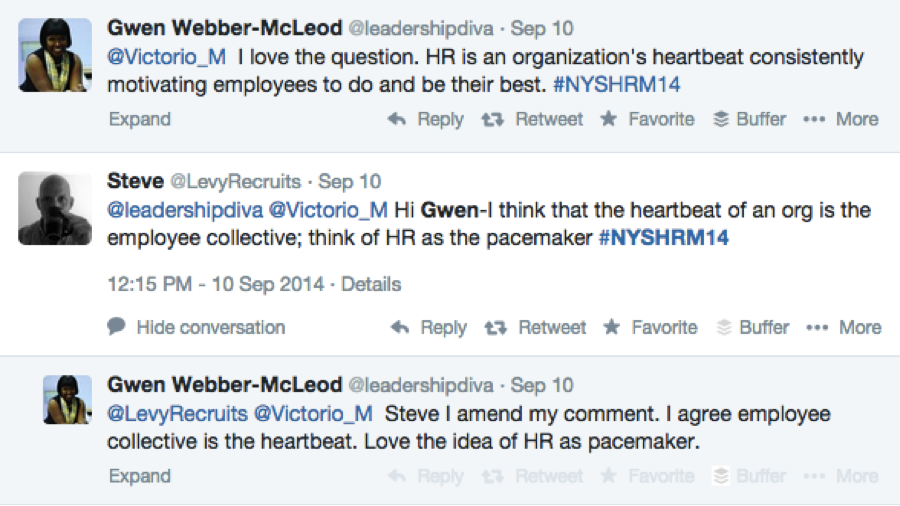
Gwen Webber-McLeod, one of the presenters at the upcoming New York State SHRM Conference in Buffalo, tweeted at last week’s #NYSHRM14 Twitter chat:

GewnHR

Now Gwen is one smart cookie – this is evident not by her agreeing with me but by her changing her opinion mid-discussion. And a fast moving one at that. HR needs more people like Gwen who aren’t afraid to change their tune mid-whistle (and she’s one of the speakers at the State SHRM conference).

The upcoming New York State SHRM Conference has many topics associated with addressing the needs of HR professionals. But what’s missing – and this is where social media can help fill in the blanks – are the substantive discussions that actually get to the heart and purpose of HR.

“Why does HR have a serious PR problem and what needs to be done to address it?” is a significant topic to discuss – rather than denying that we have a problem (quite a bit like Glassdoor ratings – where even one negative rating is a call to action to fix the problem).

Since there isn’t a formal discussion scheduled to address the Public Relations problems of HR, using Twitter and the hashtag #NYSHRM14 to bring light to the real substantive issues of our profession is the way to go. And mark my words – the #NYSHRM14 Social Media team of Victorio Milian and I isn’t afraid of taking on the tough cases…

Frankly, there are quite a number of fluff sessions scheduled that were likely designed to ensure that the State’s HR professionals leave Buffalo feeling good about themselves. (I’d just as soon spend my money on a day-pass at a local gym). That’s why I think I was asked to be one of the two official bloggers for the event – my honesty and often outside-the-box way of looking at things. Or calling out people and their positions…

My social media goal isn’t to help those who aren’t fans of HR to magically love HR; but like broccoli, to understand that while you might not like it, at least understand how it can be good for you.

Or think of it as shocking the pacemaker…

Share the Inferno's Fire...

  • Share on X (Opens in new window) X
  • Share on LinkedIn (Opens in new window) LinkedIn
  • Share on Facebook (Opens in new window) Facebook
  • Share on Reddit (Opens in new window) Reddit
  • Email a link to a friend (Opens in new window) Email
  • Print (Opens in new window) Print
  • More
  • Share on Pinterest (Opens in new window) Pinterest
  • Share on Tumblr (Opens in new window) Tumblr
Like Loading...

2,977

Posted by Steve on September 11, 2014
Posted in: 9-11, Social Media. 5 Comments

It’s 4AM on 9/11 and I can’t sleep. This day has felt like an out-of-body experience for each of the previous 11 years – I can “see” the murderers getting on the planes, I can “see” them taking control, I can “see” them crashing the airplanes into the Pentagon and Twin Towers, and I can “see” the passengers taking control of the plane that crashed in the Shanksville area.

Yet I really can still see the Towers falling.

I was on the corner of 42nd and 6th along with thousands others when the first Tower came down.

I can still hear the silence and the sobs.

This was all before social media, before bandwidth would have allowed the flow of petabytes of streaming video, before Twitter posts and Facebook Likes. The Internet had slowed to a crawl, all circuits were busy but the only technology that enabled communication were Blackberrys. Prehistoric times.

But in the weeks following 9/11, this was also when people actually talked to each other; when friends came together and shared hopes and fears; when families did things as a family, spur-of-the-moment activities that didn’t involve proving “offspring genetic superiority” to other families in the neighborhood. There were more hugs than handshakes. For a time it wasn’t about “me” but about “us”…

But 12 years later, it’s the Social Media Age, with the minutiae of our lives shared in real-time – and we’re all richer for it. We text across rooms, our Snapchats disappear, we self-anoint ourselves as Rockstars, Ninjas, Gurus, and Experts, and receive a little dopamine spritz every time someone Likes, Shares, or retweets. We document our lives in “the Cloud”, walk through intersections with our heads buried in our smartphones oblivious to traffic conditions, check work emails at 3AM.

If the memory of 9/11 has fallen off your front page because your ego-driven, marketing induced digital life has become so important, then at least for this one day think of the 2,977 who never had the chance to Tweet, Like, or Share their lives with anyone. Don’t text, talk. Don’t tweet, call. Don’t Like, hug.

Never forget…

Share the Inferno's Fire...

  • Share on X (Opens in new window) X
  • Share on LinkedIn (Opens in new window) LinkedIn
  • Share on Facebook (Opens in new window) Facebook
  • Share on Reddit (Opens in new window) Reddit
  • Email a link to a friend (Opens in new window) Email
  • Print (Opens in new window) Print
  • More
  • Share on Pinterest (Opens in new window) Pinterest
  • Share on Tumblr (Opens in new window) Tumblr
Like Loading...

When Good Interviews Go Really Bad

Posted by Steve on June 19, 2014
Posted in: Candidate Experience, Careers, Culture, Facebook, Interview, Job Search, Recruiting. Tagged: Culture Fit, Interviewing, Job Search. Leave a comment

Perhaps using humor is a better strategy for teaching the Do’s and Don’ts of interviewing. Do any of these bring back memories? Let me know in the comments…

The Origin of Job Interviews

(there’s a reason why some – okay, many – recruiters are referred to as Neanderthals)

Facebook Ruins Job Interview

(oh sure – you have a reason for everything you’ve socially posted – )

Job Interview Shenanigans

(then there’s that one candidate who could care less)

The Completely Honest Job Interview (kinda NSFW)

(what some – or many – would like to say)

“Not a culture fit” Job Interview

(You have be to your authentic self or else you’ll have a baaaaaaaad experience)

The @Tide Talking Stain Interview

(are they looking at my zit? is there a piece of food stuck in my teeth? oh nooooooo)

IT Interview Gone Wrong

(this isn’t real but it’ll still make you cringe)

Job Interview Mess Up

(bold face lies and even bribes)

“Evil” Panel Interview

(there always that one person on the panel or part of the slate you wish wasn’t there)

Share the Inferno's Fire...

  • Share on X (Opens in new window) X
  • Share on LinkedIn (Opens in new window) LinkedIn
  • Share on Facebook (Opens in new window) Facebook
  • Share on Reddit (Opens in new window) Reddit
  • Email a link to a friend (Opens in new window) Email
  • Print (Opens in new window) Print
  • More
  • Share on Pinterest (Opens in new window) Pinterest
  • Share on Tumblr (Opens in new window) Tumblr
Like Loading...

And Your SnapChats Disappear Too

Posted by Steve on June 3, 2014
Posted in: Baby Boomers, Careers, Character, Learning, Millenials, Recruiting, Women. Tagged: Baby Boomers, Careers, CEO, Entrepreneurism, Millennials, SnapChat, Venture Capital. 9 Comments

wiseNo one really checks the Internet for my past stuff

But that was five years ago – I’m a different person now

It was a private email that wasn’t to be shared

Pigs really can fly…

Evan Spiegel, CEO of the Millennially-loved SnapChat, has found himself in quite a pickle over the past few days both with the emergence of emails he wrote while a student at Stanford and for his predictable response.

His overtly misogynistic words have caused all sorts of opinions to fly at the intersection of Technology Highway and Bad Taste Boulevard. Folks on one corner are singing, “Boyz Will Be Boyz” while the opposite corner is crooning, “The Three or More Billion Dollar Devaluation Blues” – all in four-part cross-Generational harmony. And none of it is music to anyone’s ears.

Has screwing women – literally and figuratively – become a requirement for many tech entrepreneurs and their startups? Is a brogrammer culture truly the organizational structure of preference in new technology companies? When will investors begin to actually devalue companies as a result of the bad non-business behavior of company executives? Consider activities that take place in our nation’s capitol…

In Washington, DC, egregious past behavior derails a political career faster than it takes for an ice cream cone to melt while waiting on a line outside the Phoenix VA at noon on a Summer day. It’s bad enough that investment firms lack the ability and experience to assist their portfolio companies in hiring needed talent – which follows the general trend in recruiting that the barrier to entry is very low, let alone assess the leadership qualities of the young entrepreneurs appearing in their boardrooms looking for funding.

Since when did misogyny and bad taste become valued components of successful entrepreneurism and fundraising? Unless these investors also have serious skeletons in their closets, I cannot for the life of me see why they would touch investors like Mr. Siegel with a 10 million dollar Series B pole.

As far as investment firms reducing the value of a portfolio company – I’m not holding my breath…

Yet the 23-year old Spiegel isn’t alone; a very large portion of this current Generation of startup “leaders” might be the most lack-of-life and business aware group in recent memory. When you’ve been on the CEO Track since pre-school, there’s not a whole lot of time left to teach life lessons when the same responsibility lessons that were taught to the annoying Boomer generation have been replaced by devouring such classic tomes as “Dr. Seuss Goes to Entrepreneur’s School” and “Horton Hears An IPO.”

Morality and civility be damned; if they haven’t experienced it with their own two eyes, ears, and hands and received a Blue Ribbon for their efforts, it just ain’t true.

So while I have been writing somewhat for effect and shock-value – of course, I don’t believe that most Millennials are egotistical snot-rags – there are extremely important bits of life advice here that must start with untangling what has been reinforced in the heads of our early careerists (a kinder, less emotionally-driven form of the label, ”Millennial”).

Mark Babbitt, CEO of YouTern.com, wrote an especially heartfelt post based on his life experiences and abundance of practical wisdom in which he postulates that today’s college grads must unlearn 6 things they learned in college that they have been brainwashed into believing were true and inviolate.

Read it – and just pause long enough to ask yourself if Mark is right. No…wait a decade or two, have a family, catch a few of life’s curveballs and knuckleballs, then break out the list again and see if Mark’s words make sense to you.

One thing he’s not doing is denigrating you and your thoughts; the reason I know this is that we were actually once you, and we also believed the same shuck and jive that you believe to be true about college, work, careers, and life. Many of us still possess and are driven by that wild-eyed, we-can-do-anything-our-minds-can-dream-up joie de vivre but we’re somewhat limited by the cards we’ve been dealt from the deck of life’s responsibilities.

We have no ulterior motives here but to point out life’s land mines and patches of quicksand in the hope that you can actually get to where you want to go by minimizing the personal and professional train wrecks we’ve experienced. My motivation is simple – no one did this for me. While my parents weren’t college educated, they worked hard, offered an immense amount of love and encouragement, taught important lessons about responsibility, honesty, integrity, and perseverance, and always told me that if I wanted to finish first I had to work harder and smarter, and be kind to everyone around me. They never taught me to “wait my turn” but to simply “do my best.”

Yes, there have been times when I’ve strayed from the lessons my parents taught; most everyone does – often without knowing. Yet there’s a Zen saying by Ch’ing-yüan Wei-hsin that alludes to how wisdom can eventually come to those who are aware…

Before I had studied Zen for thirty years, I saw mountains as mountains, and waters as waters. When I arrived at a more intimate knowledge, I came to the point where I saw that mountains are not mountains, and waters are not waters. But now that I have got its very substance I am at rest. For it’s just that I see mountains once again as mountains, and waters once again as waters.

Again, we’re not Baby Boomers – but we are older versions of you with the scars to prove it.

Back to Mr. Siegel the early careerist…

I’ll bet most of you didn’t know that the original name of SnapChat was Picaboo – as in the childhood line, “Peek-A-Boo, I see you.” Or that it really was discussed as a sexting tool.

Isn’t it ironic that Spiegel helped to create a tool that enables others to behave the way he likely did while in college without being caught so they wouldn’t feel horrible and embarrassed? In his “younger days” emails, he encouraged his fellow frat boys to get sorority women drunk enough to have sex with them – this is literally rape. According to RAINN, there’s an average of 237,868 victims of sexual assault and rape annually in the United States – meaning every 2 minutes someone is sexually assaulted.

This is why Spiegel’s original emails, his tepid apology, and the outpouring of disgust – and alas, support, is a very big deal. And he’s giving YOU a really bad name because many young and old are referring to him not as the SnapChat CEO but as another spoiled, clueless Millennial.

Time to get your collective acts together, look in the mirror, and join the part of the human race that has developed its own collective sense of practical wisdom. Be kind to everyone – and if you slip, apologize. Stop living your label; stop giving ammunition to those who want to package you along with others your age – even the ones who are behaving badly and are transferring their stench to you by label proxy. Stop wanting to be like them – because success in life is measured more in kindness than net worth.

One day you will wake up and you will be me. You will be older. You will have more wrinkles. You won’t be able to eat the 15 tacos like you used to on Taco Tuesdays (please believe me – you’ll try). You will have made some exceptionally good career choices; you will of made some exceptionally bad ones. You will have had some exceptionally good bosses and some exceptionally bad bosses.

One day you will say things, then you’ll look over you’re left and right shoulder for your parents – because you have become them. Sounds frightening? Well – it shouldn’t. It’s the real circle of life.

measuretwicecutonceUntil then, remember to keep your words short and sweet because one day you might have to eat them – and no one will be there to clean up your puke. Just as carpenters know to measure twice, cut once, learn to count one-two-three Mississippi before your take that picture or click <Send> before that email enters the Land of No Return.

If you still think that we’re jealous, techno-idiots who have no idea what you’re going through, you might just discover that your sure-thing business idea that you figured would make you a Billionaire has only made you a Pariah because you failed to heed the advice of old bastards who just wanted to help.

And you better hope that those SnapChats really have disappeared…

Share the Inferno's Fire...

  • Share on X (Opens in new window) X
  • Share on LinkedIn (Opens in new window) LinkedIn
  • Share on Facebook (Opens in new window) Facebook
  • Share on Reddit (Opens in new window) Reddit
  • Email a link to a friend (Opens in new window) Email
  • Print (Opens in new window) Print
  • More
  • Share on Pinterest (Opens in new window) Pinterest
  • Share on Tumblr (Opens in new window) Tumblr
Like Loading...

Exit Interviews and Septic Tanks

Posted by Steve on May 6, 2014
Posted in: Recruiting. Tagged: Boomerangs, Exit Interviews, Recruiting. 2 Comments

ImageOne problem with Exit Interviews is that they treat exiting a company the same old tired way – something the company did caused the person to leave.

We must find the reason! We must rehabilitate or fire the person responsible! What did we do wrong that caused the person to leave? What did the other company do that we didn’t?

I’ve always used an Erma Bombeck strategy when conducting exit interviews; her book, “The Grass Is Always Greener Over The Septic Tank” highlights the technique…

Seriously, my first question in an exit interview is “What is the one best things about having worked here?” Since there’s ALWAYS something, this leads to another and another and pretty soon there’s a list of positive reasons to possibly return down the line. Armed with this awareness, the person leaves with some “positive doubt” about their tenure. Which is a very good thing.

You see, every exit should set up the boomerang return – unless the person truly is someone you don’t want back (even then, unless you’re a dyed-in-the-wool pessimist, you have to believe that everyone can change their negative behaviors).

These positives then set the wheels in motion by which the person more accurately compares the new with the old. It’s really magic.

Alas, emotional intelligence is often forgotten during the trying times of someone leaving a company. Too bad…

0.000000 0.000000

Share the Inferno's Fire...

  • Share on X (Opens in new window) X
  • Share on LinkedIn (Opens in new window) LinkedIn
  • Share on Facebook (Opens in new window) Facebook
  • Share on Reddit (Opens in new window) Reddit
  • Email a link to a friend (Opens in new window) Email
  • Print (Opens in new window) Print
  • More
  • Share on Pinterest (Opens in new window) Pinterest
  • Share on Tumblr (Opens in new window) Tumblr
Like Loading...

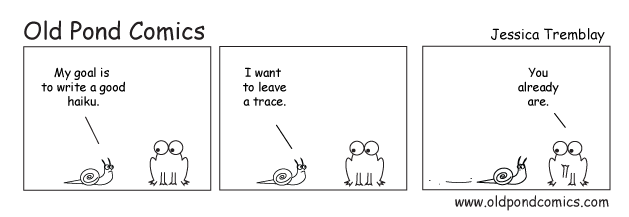
Sunday Recruiting Haiku

Posted by Steve on May 4, 2014
Posted in: Poetry, Recruiting. Tagged: ATS, poetry, Recruiting, snark, sourcing, Twitter. 2 Comments

SnailHaiku

Twitter Chats

“Experts” roar –
Leaves fall from the trees
No one hears barren limbs

Linkedin InMails

“Love” works –
Matching buzzwords with more love
Sorry…not enough <trash>

Job Descriptions

The Title screams –
Yes, a Software Developer
Does code…really?

Applicant Tracking Systems

I’ll eat you –
I will…but I don’t like
PDFs? Um, wrong…

Sourcing

Black Belts shine –
Boolean Masters…pipelines flow
So where are the Rockstars?

We  Only Hire the Best and the Brightest

If you say it, mean it –
Hiring “Best” means You
Best recruiters? Really?

0.000000 0.000000

Share the Inferno's Fire...

  • Share on X (Opens in new window) X
  • Share on LinkedIn (Opens in new window) LinkedIn
  • Share on Facebook (Opens in new window) Facebook
  • Share on Reddit (Opens in new window) Reddit
  • Email a link to a friend (Opens in new window) Email
  • Print (Opens in new window) Print
  • More
  • Share on Pinterest (Opens in new window) Pinterest
  • Share on Tumblr (Opens in new window) Tumblr
Like Loading...

Recruiting is Broken

Posted by Steve on April 10, 2014
Posted in: Recruiting. Tagged: CEO, entrepreneurs, Recruiting, technology. 1 Comment

[What follows is an account of a successful early careerist having a career discussion with an influential mentor]

Recruiting Technology

Recruiting Technology

After I graduated from Harvard and took my first job as an investment banker earning $150K, upon returning home for Thanksgiving my Mom cornered me in the kitchen and in an exasperating tone asked (or rather, demanded), “You’re 26 years old – [raising her voice] WHY AREN’T YOU A CEO ALREADY LIKE YOUR FRIEND JIMMY? I AM SO FREAKING TIRED OF LISTENING TO HIS MOM LINDA BRAG ABOUT, ‘JIMMY’S A CEO, HE HAS ANGEL INVESTORS, HE’S GOING TO BE A BILLIONAIRE’ – WHEN THE FUCK ARE YOU GOING TO PAY ME BACK FOR ALL THE YEARS I BATHED YOU, FED YOU, CHANGED YOUR GOD-DAMNED DIAPERS? WHEN ARE YOU GOING TO START YOUR OWN COMPANY AND BE A CEO? WHEN, WHEN, WHEN?!?!”

[In a calm soothing voice] “But Mom…”

[Mom’s really pissed off now] “SCREW ‘BUT MOM!’ WILL YOU JUST START UP A DAMN COMPANY THAT FIXES RECRUITING?!?!”

Oh, if it only were this easy.

And yes, it is the reason why “new” recruiting technology is exploding globally – because entrepreneurs truly believe that technology, any technology, will cure the ills of recruiting.

In The Future of Recruiting and Hiring Technology, Sharlyn Lauby of HR Bartender fame says, “When you automate the right tasks, then it frees up time to do the in-person ones better.”

The problem here is in how the entrepreneur (a) comes to their conclusion that recruiting is broken; and, (b) comes up and develops a solution that will undoubtedly make them an Angel’s or VC’s pet. In other words, Sharlyn would be spot-on if the underlying recruiting processes were optimal and the recruiters tasked with implementing the processes were optimal as well. Neither is.

Automating the “right” tasks is what stumps most recruiting technology entrepreneurs; are they automating the right task or a part of a process that is broken, aging, or downright useless?

Here’s a typical comment about a better way to recruit (this one is pasted from the above article – all I’ve done is turn on italics):

The fundamental assumption that recruiters need to do more outreach, be it automated is wrong.

Recruiting should and will become more inbound. Should companies always reach out to potential talent (be it on the form of automatic mails)? Shouldn’t technology actually make engagement and data driven hiring more efficient. The problem with many technologies being developed today is that recruiting is still seen upon as a filling up a job and not in terms of making a career. Take the very successful companies like Google, Netflix. Apart from posting jobs (if they post i.e.), do they do direct selling of their position.

The future of recruiting is in inbound marketing. If one tries to understand the relationship between marketing, sales and recruiting you would see a pattern. Marketers are early adoptors, Sales adopt technologies and practices if they seem to be successful in marketing. Recruiters are generally late adopters.

The likes of Amazon, Apple etc (I consider them as Sales and Marketing Companies, these companies buy and sell stuff and keep a margin) etc are focussing on more inbound tactics. They do marketing and not sales. These companies don’t buy email databases and send mass mails. They put the right ad in front of the right customer and gets their sales done.

I see recruiting too moving in that direction. If a company is able to post the right job in front of the right candidate, the sale is going to happen. How can this happen?

1. Replace job description with tasks : Job Description are dead, no candidate has the time to read them. Just like a recruiter looks at keywords in resumes, the talent looks for keywords. Product companies are already doing task based sourcing and hiring
2. Focus on inbound : The really successful companies focus on inbound recruiting. This is about a.identifying those right nodes and playing them in front of the candidate b.keeping your employees happy who in turn will lead you to more talent.
3. Push careers : Imagine you are a highly talented candidate. One company offers you a job and a really good package. There is another company which is offering you a job, a well defined career progression cycle (Things like google’s OKR based promotion cycles) and a decent salary. Which one would you chose?

The future of recruitment technology is not about outbound tools, it is about creating tools that would lead to inbound recruiting.

PS : This is a sales pitch. if you believe in what we do, check out HuntShire.

A sales pitch. Ah, I hadn’t noticed. Anyone want to guess how many years of recruiting experience the team of three co-Founders has between them?

Is there anything in this fellow’s sales pitch that makes you confident that he understands the ins and outs of recruiting – the Good, the Bad, and the Ugly? What I do see is a rehashing of the same phrases we’ve been hearing for decades – like “Job descriptions are dead, no candidate has the time to read them” – and a pitch for a “better way.” Ho-hum, wake me up before you go-go…

If it’s not replacement for job descriptions, it’s gamification; if it’s not gamification, it’s mobile; if it’s not mobile, it’s how to recruit software developers. It’s a new ATS, a new assessment tool based upon the teachings of Carl Jung (yes, I’m being sarcastic), a new social job board that no one has thought of before.

My point here is not to denigrate entrepreneurism or recruiting technology but do you see what’s missing from all this new recruiting technology?

The recruiters…

The company leaders and how they view the importance of recruiting…

The hiring managers (notice how much recruiting technology takes recruiting away from recruiters and places it back into the hands of the hiring managers)…

The jobseekers…

How often do recruiting technology entrepreneurs with a better way conduct focus meetings with not just someone from each category but with someone from each category who is good, bad and even ugly? How often do these focus meetings result in a re-engineering of a “flawed” process? Or is this new recruiting technology designed to make easier a flawed process?

I’m asked to review more recruiting technology than I’d like but as part of my personal belief in stewarding the recruiting profession, I rarely decline the chance to see if the reality meets the hype. I listen to the person’s background, where they went to school. I breathe in all the words of the pitch, the reason why recruiting is broken.

Finally, I’m given a business card with a phone number and email to call later to discuss.

And the title reads, “CEO”…


[Cross-posted on RecruitingDaily.com. Don’t receive it? Sign up for RecruitingBlogs – it’s free – and get it. Great place for recruiters, hiring managers, career services professionals AND jobseekers]

0.000000 0.000000

Share the Inferno's Fire...

  • Share on X (Opens in new window) X
  • Share on LinkedIn (Opens in new window) LinkedIn
  • Share on Facebook (Opens in new window) Facebook
  • Share on Reddit (Opens in new window) Reddit
  • Email a link to a friend (Opens in new window) Email
  • Print (Opens in new window) Print
  • More
  • Share on Pinterest (Opens in new window) Pinterest
  • Share on Tumblr (Opens in new window) Tumblr
Like Loading...

The Modern Recruiter

Posted by Steve on April 3, 2014
Posted in: Recruiting. Tagged: recruiter, Recruiting. 5 Comments

What is a modern recruiter? Someone who is honest first, knowledgeable second, consistent third, humble fourth, helpful fifth, personable sixth, and resilient seventh – of course these are equally valid in other arrangements.

Too many people who call themselves recruiters don’t take pride in their craft; aren’t continuously learning; believe they have ESP-like abilities to read a person’s body language during an interview or read between the lines of a resume; assume the job down on paper describes the real job; and recoil when asked questions about how they do their jobs. They use their mouths and ears in inverse proportions…

These are the folks who came into the profession because the barrier to entry was so low; the truly professional modern recruiter – doesn’t matter where they practice their craft in-house or out-house – believes that they didn’t find recruiting but recruiting found them. They feel a personal responsibility to steward the profession.

Excellence first, paycheck second.

Share the Inferno's Fire...

  • Share on X (Opens in new window) X
  • Share on LinkedIn (Opens in new window) LinkedIn
  • Share on Facebook (Opens in new window) Facebook
  • Share on Reddit (Opens in new window) Reddit
  • Email a link to a friend (Opens in new window) Email
  • Print (Opens in new window) Print
  • More
  • Share on Pinterest (Opens in new window) Pinterest
  • Share on Tumblr (Opens in new window) Tumblr
Like Loading...

Culture Change Isn’t About Beer, Climbing Ropes, or Yoga

Posted by Steve on March 17, 2014
Posted in: Change Management, Culture, Employee Engagement, Leadership, Strategy. Tagged: Change, Culture, Leadership, Mission, Values. 2 Comments

Cookie cutter values? A simple search will demonstrate that most Mission & Values statements are repetitive; with so many companies touting similar values, why are so many companies underperforming, why are tenures shorter, and why do HR folks love talking about how great they are at engagement? That’s easy: Shit rolls downhill…

Ever heard about The Monkey, Banana & Water Spray Experiment? The experiment is “real” (some of the quotes at the bottom are “interpretive”); it involved 5 monkeys (10 altogether, including replacements), a cage, bananas, a ladder, and an ice-cold water hose.

The Experiment: Part 1

5 monkeys were locked in a cage, a banana was hung from the ceiling, and a ladder was placed right underneath it. As predicted, one of the monkeys immediately raced towards the ladder to grab the banana. However, as soon as he started to climb, the researcher sprayed the monkey with ice-cold water. In addition, he also sprayed the other 4 monkeys…

When a second monkey tried to climb the ladder, the researcher sprayed the monkey with ice-cold water, as well as the other 4 watching monkeys. This was repeated again and again until they learned their lesson – climbing equals being sprayed with ice-cold water for EVERYONE – so no one climbed the ladder.

The Experiment: Part 2

Once the 5 monkeys knew the drill, the researcher replaced one of the monkeys with a new inexperienced one. As predicted, the new monkey spotted the banana, and went for the ladder. The other 4 monkeys, knowing the drill, jumped on the new monkey and beat him up. The beat-up new guy thus learned “don’t go for the ladder and no banana – period” without even knowing why and also without ever being sprayed with water.

These actions were repeated 3 more times, each time with a new monkey; each time each of the previous new monkeys – who had never received the ice-cold water spray himself (and didn’t even know anything about it) – would join the beating of the new guy. Eventually, none of the original ones that had been sprayed by water are left in the cage.

The Experiment: Part 3

Finally, a new monkey was introduced into the cage. It ran toward the ladder only to get beaten up by the others. The new monkey turned with a curious face and asked the other monkeys, “Why do you beat me up when I try to get the banana?” (a monkey translator was present).

The other 4 monkeys stopped and looked at each other puzzled – none of them had been sprayed and so they really had no clue why the new guy can’t get the banana – but it didn’t matter, it was too late, the rules had been set. Although they didn’t know WHY they beat up the monkey, one of them spoke up and said, “That’s just the way we do things around here…”

And people wonder why changing a culture is so difficult…

Changing culture requires far more than fluffy things like paying high-priced consultants to create new M&V elements; it’s far more than changing the brand of beer on Fridays, climbing retreats for executives, or yoga on Wednesdays for all employees. It involves a drastic and dramatic unraveling of a can of worms and a pile of pickup sticks in search of a special needle in a haystack.

#Tchat and #NextChat participants take note.

FYI, this culture joke is loosely based upon Stephenson, G. R. (1967). Cultural acquisition of a specific learned response among rhesus monkeys. In: Starek, D., Schneider, R., and Kuhn, H. J. (eds.), Progress in Primatology, Stuttgart: Fischer, pp. 279-288.

0.000000 0.000000

Share the Inferno's Fire...

  • Share on X (Opens in new window) X
  • Share on LinkedIn (Opens in new window) LinkedIn
  • Share on Facebook (Opens in new window) Facebook
  • Share on Reddit (Opens in new window) Reddit
  • Email a link to a friend (Opens in new window) Email
  • Print (Opens in new window) Print
  • More
  • Share on Pinterest (Opens in new window) Pinterest
  • Share on Tumblr (Opens in new window) Tumblr
Like Loading...

Building A Car, Building A Career

Posted by Steve on February 8, 2014
Posted in: Recruiting. Leave a comment

Last evening I sat in on a “Career 3.0” session at NYU that was in part sponsored by the NYU SHRM Student Chapter. 200+ early careerists came looking for specific job search and career management – I think they received some useful tidbits but nowhere near enough for a chilly Friday NYC evening. Some – but not enough.

Overall, the advice sounded dated, “lectured”, and ubiquitous: “Show Passion”, “Be authentic”, “Practice your elevator speech”, blah, blah, blah. The students and early careerists in the audience hear this “rah-rah” advice daily but are rarely given specific tactics and techniques beyond a boilerplate. It’s like telling someone who has never built a car to go build a car by pointing to an assembly line and saying, “See?” In the career space, the advice is, “Go research; go network. See?” – then turn and say the same thing to the next person.

For example, many students in the audience are multilingual and want to use their language skills. Where are the opportunities? Are language skills important? What should we do?

Crickets.

Which should never be unexpected – because the most useful answers to the truly complex career and job search problems aren’t the standard “the color of your parachute is…” The most personally game changing answers require “lateral thinking” – and often the answer is so elegantly simple that the question asker is left I smile a crooked smile and think, “Now why didn’t I think of that?” Alas, lateral thinking isn’t taught in school; it is left for a scant few to learn through trial and error when in reality it isn’t a difficult skill to learn (read everything you can about Edward de Bono).

As for the language skill opportunities, let’s use Russian as an example (one if the students’ Mother tongue). I showed her that by Googling “US Russia Business Council” you actually get the US-Russia Business Council website. See that Members link on the navigation bar? Click. BAM! All US and Russian companies in the council.

Works for any language and country.

Next step is to do some advanced LinkedIn research and identify the person who serves as the head of the function you want to be on or the person who is the Council liaison. Heck, maybe they graduated from YOUR school or is from your home town.

When you send that LinkedIn request, write it in BOTH languages.

Again, just one example.

I wish career experts would just drop their boilerplate advice and actually ponder how they sound like just another talking head. No one deserves receiving career advice from a bobble head. You can’t teach a novice to build a car by pointing at a whirring assembly line…

So…any specific questions from you?

Share the Inferno's Fire...

  • Share on X (Opens in new window) X
  • Share on LinkedIn (Opens in new window) LinkedIn
  • Share on Facebook (Opens in new window) Facebook
  • Share on Reddit (Opens in new window) Reddit
  • Email a link to a friend (Opens in new window) Email
  • Print (Opens in new window) Print
  • More
  • Share on Pinterest (Opens in new window) Pinterest
  • Share on Tumblr (Opens in new window) Tumblr
Like Loading...

Posts navigation

← Older Entries
Newer Entries →
  • Enter your email address to follow #RI and receive notifications of new posts by email

    Join 358 other subscribers
  • 140

    Tweets by LevyRecruits
  • New Fires

    • Dear Isaac
    • Keeping or Doing: The TA Leader
    • Candidate Experience Metrics That Make Sense
    • Anatomy of a Rejection Letter
    • TA Musings
  • Old Fires

  • Post Categories

  • Tags

    #HFchat #InternPro #JobHuntChat #NYSHRM14 9-11 AI artificial-intelligence ATS BabyBoomers Baby Boomers begging blogtalkradio Boomerangs Bruce Lee Bullhorn Reach Careers CEO Change Christmas commuting Conference cover letters Culture Culture Fit douchebag emails employee engagement Entrepreneurism entrepreneurs Ethics Exit Interviews FauxLinkedIn GenX GenY hr Incentive interview Interviewing job Job Descriptions Job Search jobseeker jobseekers Leadership LinkedIn metrics Millennials Mission MTM phishing poetry recruiter recruiters Recruiting Recruiting Association Referral resume scam SnapChat snark Social Media sourcing Spam staffing strategy stupid jobseeker tricks subway talent-acquisition technical technology Tweetup Twitter Values Venture Capital Water
Blog at WordPress.com.
The Recruiting Inferno
Blog at WordPress.com.
  • Subscribe Subscribed
    • The Recruiting Inferno
    • Join 358 other subscribers
    • Already have a WordPress.com account? Log in now.
    • The Recruiting Inferno
    • Subscribe Subscribed
    • Sign up
    • Log in
    • Report this content
    • View site in Reader
    • Manage subscriptions
    • Collapse this bar
 

Loading Comments...
 

    %d