There’s a story of a woman who sold fish all her life and knew nothing else. One summer day, she was invited to the queen’s palace to help prepare a royal festival. When she was shown to her room, she found it filled with fragrant flowers. How disgusting, she complained. Please take me back and let me sleep near my pile of fish.
She choose the stench of fish over the sweet fragrance of flowers because of habit and familiarity. It’s the choice of picking the devil you know versus the devil you don’t.
In the same way, we often hold on to our angers and sorrows, our bitterness and mediocrity because they are all we know. They offer familiarity – and oddly comfort – in a very uncertain world.
But as soon as we realize that we can choose self-worth, approval and appreciation over pain and fear, a powerful force begins to churn inside. Over time, this force can be used to nurture the creativity and power needed to break the shackles that keep us tied to the standard ways we work.
Recruiting today is very much like this. Calls, calls, calls are the ingrained way of the business when in fact relationships are built with face to face meetings. We use trite phrases like it’s a great place to work when selling a job to a person when we’ve never spent a day at the company. We sell candidates to companies by saying the person has a great attitude when we’ve never assessed the fact.
We’ve been recruiting from a room filled with fishes and continue to do so because its the only way we’ve ever done it.
Try this: If you’re going to sell a company perhaps you should ask to spend a day there; if you’re recruiting for a specific function, attend their monthly meetings; if you want to sell someone’s attitude, place them in noxious environments and see how they respond.
Unless you really do prefer the stench of fish.
[Thanks to Lou Tice of The Pacific Institute for the inspiration]
After ERE, I wrote for RecruitingBlogs from July 8, 2008 through Oct 27, 2010. This post – from 4.19.2009 – was one of my favorites of the 240-ish posts I authored:
I just finished reading this article entitled, Let Them Eat Tweets and like the author, I too can’t help but think that social media is sucking users into a vortex whose pull and power from which they can never escape. In fact, as in as social media may be – and I’m a heavy user so don’t call me an ignorant naysayer – I believe it is forming a nasty mass of societal sludge. It’s dual action cleanse time!
Also in the Times article was mention of an interesting site, Twistori (just wait a few seconds when you go here; I really like Amy Hoy’s blog – she’s one of the developers), which lists tweets according the presence of one of the five words: love hate think believe feel wish.
Read these for a few minutes: And how will Twittering help improve the human condition?
While reading reams of Employee Engagement advice, I’m continuously reminded how “buzzwordian” it all sounds. Typical tweets discussing employee engagement are like this one:
“Engagement means an alignment with employees feeling authentically connected to an org and its values.”
Huh? Reminds me of cow excrement followed by the word Bingo…
Guess that’s why PhD stands for “Piled higher and Deeper.”
Perhaps I’m different; I’m an engineer who crossed over to the dark side – HR and recruiting – who at various times has been responsible for a company’s recruiting AND organizational development initiatives (as I like to describe it, my groups had to find them and keep them). And the engineer in me knows that you can’t build things that last out of smoke and mirrors.
Rather than talk about engagement using the same lethargic lexicon, here are a few specific ideas on engagement that have worked for me:
Ask employees to describe a specific time when a manager or existing “process” hindered them from doing their job and how they felt. Likewise, ask them to describe a specific time when a manager or existing “process” positively helped them to do their job and how they felt. Details are critical – who, what, when, where, why. Understanding the people and processes behind engagement and disengagement are the drivers behind taking down barriers and building more effective “structures.”
In one instance, this approach led to the discovery that 3 business units were effectively running parallel development operations; the solution was to retask people and resources to work on common platform elements that were core to all units. Lots of “didn’t know you could do that” as a result of collaboration. And of course, “wow, someone listened” (which was the CEO whom I brought in to these first cross-BU collaboration meetings).
Learning & Development are great but they have to be focused on critical “is-now” and “will-be” problem solving. For instance, if you’re implementing open-book management, you sure as heck need to teach non-financial employees some balance sheet principles. Someone has to directly tie all this new material to the person’s current role. This means that managers have to be in the room when their folks are learning new things so they can make the connections between new stuff and existing roles.
I’ve led many brown-bag-like sessions for recruiters where I introduced some cool way of sourcing purple squirrels or engaging the unengageable. For me, there have always been two key elements of this: One, the technique is very narrowly focused rather than being something overly broad like “This is how you source people”; and two, the technique is applied to a specific role that each recruiter is in the process of filling (AKA, the session is highly targeted). Invariably, there are many I-didn’t-know-you-could-do-that comments followed by “Are there other things you can show us?” Cool.
Don’t just hire people who fit your culture and share your organizational values.Hire people who can also shake up your sacred culture. Identify people whose skills sets and problem solving experiences can take your company to new places. It’s laughable when company’s spout off loudly about their disruptive technology yet won’t hire disruptive employees. Value alignment is not culture fit – it’s value alignment (like being customer focused, blah, blah, blah). Culture shouldn’t be a Wailing Wall but more like a containment boom that flexes.
Examples? The developer with the 2.22 GPA whose programming ability was exquisite; the head of Software Development who came from one of the world’s greatest technology think tanks to join a start-up headed up by a “a very interesting CEO”; or the crazy places who took a chance on an engineer who for some reason likes HR and recruiting.
Employee Engagement isn’t an exercise to see who can come up with the most quotable phrase; it means first getting down and dirty at the grassroots level of a company and finding out why the financial, operational and organizational elements aren’t all together being happy followed by mapping the reasons for all the unhappiness to those sacred values and business goals, and finally prioritizing them with managers and business leaders with the goal of every employee achieving their own level of superstardom.
In other words, figure out what it takes for people to do their job better than they thought possible and remove all the obstacles in their way.
And if success means poking holes in your Wailing Wall of Culture, so be it.
Social Media is all four except that users always seem to forget where they are – and who can read them – when they press <Send>. Of course, the four rooms do not have the same decor nor do they attract the same people. Problem…
My buddy Mark Babbitt, CEO of YouTern, likes to inform college students about things they’re likely not to receive from their university’s career center; one of his favorite media is blogging. Yesterday, he posted a nice piece on how recruiters are using social media to learn a few things about people whom they might have an interest in recruiting.
I often like his posts so much that I lean towards writing blog-length pieces as comments; I figured that since some people might not read these pearls of wisdom (I chuckled as I wrote that), I might as well pop them into a blog post myself and see if this helps drive traffic – and comments – to both our blogs.
My comment:
Mark, as for how I use social media to “research” people, let me first offer up a simple rule I use: Does what I see or read pass the “So what?” test. I know this rule is lost upon many recruiters and hiring managers when it comes to elements outside the resume but it really should apply to all.
So when I read something “unusual” (which according to my thick-skinned standards might be “very unusual” to a Cyndy Trivella who lives in KC) I put it all into the context in which it is delivered. “Miscues” don’t bother me unless you make it a habit of miscuing over time (time might be 6+ months) – yes, this means that if I’m interested in you I read pretty much everything I can find about you. If your behavior sounds like you might have the potential to be a PITA employee then I’ll probably still reach out to you – except now I’m going to ask about your predilection to using expletives the same way I down a bag of kettle cooked potato chips.
The opposite side of the coin also raises eyebrows; if you’re overly conciliatory and won’t take a stand, I’m wondering if you ever get off the fence. Of course this position of yours will also be addressed in an interview.
Personal Branding Inconsistencies
How can a brand be inconsistent when most people project a brand they think others – employers – want to see? If you tweet out “Gawd, will this day everend!!!” yet it’s 10PM and you’ve been grinding since 8AM, I’m okay. You the see word again is “context”; lazy recruiters and hiring managers will ping a point in time and extrapolate that to a character flaw. Who’s being inconsistent now?
For me, I could care less that you’re being authentic – I care that you’re being honest. Believe me – that matters…I know.
Written Communication Skills
Spontaneity is not an excuse for not thinking; yet the limitations of 140 often require you to shorten stuff and sometimes it just reads stupid.
Like email in the bygone days, review and think before you send.
Trending Health Issues
I don’t care about your sickness if your work appears to show me that you “git er done” and frankly there are employment laws that make denying people “employment” for health issues a crime.
Frankly if companies really want to go this far to deny employment and enter the “I can’t believe you’re that stupid” contest, why not simply deny all non-menopausal women the chance to work?
Lifestyle Changes
Mark, I had to really think about this. The phrase “indentured servitude” then came to mind. Then the highly touted “work-life balance”. So if recruiters are looking to DQ you then I’d say there are many schizophrenic companies out there.
Since you might remember that my Mom died of Cancer and Alzheimer’s, I hope you allow me to indulge young job seekers whose parents might be going through a divorce or one of their grandparents: Life happens.
Now I might have an issue with how you share such personal stuff on social media, I also know that this is one true generational difference. Still, I’ll look at what you’re offering and balance that with what you can offer me as an employee.
Life happens and it’s your choice to share it; again, does it pass the “so what?” test.
So yes, many recruiters look at your social stream when sourcing and recruiting but here’s the one big difference between the really great recruiters and the really bad ones: The really great ones use all the available information to INCLUDE you while the crappy ones use the same information to EXCLUDE you.
So there you go…while Mark and I might have a few differing thoughts, the bottom line is that social media is a blessing and a curse. Social media in some way is like a gun: In the wrong hands, both are very, very dangerous. Tweet wisely…and be aware of which room receives your pearls of wisdom.
Now we must ready ourselves for the reality show equivalent of a corporate Weakest Link-Biggest Loser where a “dysfunctional company will task employees with deciding whether to dismiss one of their own.” Yes – you read that correctly: We’re going to see HR 360 Live in Pink-Slip Technicolor with nary a hint of training.
Where Undercover Boss is all goodwill and puppy dogs, this ridiculous reality rumpus is, as one writer put it, just another step towards televised executions. Darn – forgot to tell you that the concept was originally pitched in 2009 and a pilot was filmed. Somehow the idea was mothballed but it’s clear that the moths are flying once again. Do we really need another reality show equivalent of stopping one’s car at the scene of a traffic accident to see if someone is hurt?
I can’t help but wonder if the head of HR for Fox’s parent company, News Corp, was consulted – or even told about the concept (I know him). Somehow I doubt it…
So I’ll leave you with a final question that I’m hoping some of you will answer:
Do you think the News Corp and Fox employment brands might be impacted by the show?
If you’re in a job search – or thinking about entering into one – you’ve concluded that life isn’t a exactly a bowl of cherries these days. There’s conflicting counsel from university career centers, social media icons, recruiting leaders, heads of people, news outlet writers, and even your own family as to how best find a new professional oasis – and often the advice is nonsensical and counterintuitive.
Yet I’m sure you haven’t heard from the latest – and perhaps greatest of all experts…Honey Boo Boo. Alana and her family sure do have class – and crass – covered.
Let’s ponder about what Honey Boo Boo has to say and what it might mean to you:
“I like to get in the mud, because I like to get dirty like a pig.”
Yes, job search – just like recruiting – is a contact sport; you simply cannot expect a positive outcome if you aren’t willing to get down in the mud, shake hands, and meet people. 140 alone will not get you a job nor will spending all your time “building your brand”; it’s critical that you get the heck away from your computer.
“A dolla make me holla Honey Boo Boo!”
It is vital that you know what motivates you to do well and assess whether the new job and the new manager will offer you the environment and leadership to help you perform your best; settling for something that won’t work for you is a disaster waiting to happen. It’s really okay to say “NO” to an offer if you ain’t a-hollerin’ by it; believe me – the recruiter and hiring manager will appreciate your honesty and might just make a few calls on your behalf.
“I’m a superstar because I do paaaageants.”
Honey Boo Boo knows that you won’t become a beauty queen if you don’t take the stage. Underlying this principle is that the best people tend to participate in activities that get to showcase their skills and abilities; they lead, present, and volunteer at local associations. Are you doing these?
“Those others girls must be crazy if they think they’re gonna beat me, honey boo boo child!”
You have to believe in yourself if you want to achieve that goal of being the person selected for the role; there will be times when you’re down on yourself – let others know this and tell them to pick you up. You know the wisdom – your attitude dictates your altitude (of course you also have to be realistic and in the case of Honey Boo Boo, have a great shtick and a wack-nut of a mother who believes in you) – so don’t succumb to the “woe is me” disease.
“My momma thinks she’s all that and a pack of crackers, but she’s not.”
See above; in a successful job search you need people to both build you up and to keep you grounded (share your ups and downs and listen to the advice of others). As much as June believes she’s the greatest, Honey Boo Boo knows otherwise and sure ain’t afraid to let the world know ‘bout it. Took me long enough to get into my thick New Yawk head that I wasn’t the greatest recruiter ‘round either (talk about a negative attitude). Now if only some would see that while I’m not Gawd, I am pretty good… ;)
“My momma weighs the most in the family because she’s fat. TRUTH.”
See above and above above…
“I hope mama don’t eat Glitzy. She eats everything else.”
See above…and don’t make a pig of yourself either; share the job leads that wash across your transom with others who also need them.
“Pumpkin’s going to be a natural.”
Listen to the people who know you very well; they’ll tell you if pig-feet bobbin’ is for you.
“It’s called a biscuit ‘cause it looks like a biscuit, ya know, when it opens up…”
Sorry. Had to toss this one in even though I have no idea how it relates to a job search; if you can relate this to a job search and I laugh, I’ll help you with your resume.
“If I don’t talk with my mouth full, when am I gonna talk?”
Yet always remember that you have two ears and one mouth – so use them proportionally.
“All that vajiggle jaggle is not beautimous.”
Yup… It’s important to look good when you’re in a job search; at any time you may be in a position to meet someone who can open the door for you…It might mean pulling up your pants so they’re not hanging halfway down your arse or showing just a bit less décolletage or tossing out a few less epithets. And for certain, keep the vajiggle jaggle at home.
“No one can be proper and etiquettely all the time.”
I’m guessing this has something to do with being authentic but I’m sure afraid to ask.
“It’s all about Southern pride, similar to the Olympics, but with a lot of missing teeth and a lot of butt crack showing.”
Pride in knowing what you want to do – and what you don’t want. Pride in creating a resume that speaks to the hiring manager. Pride in researching the company, the industry, the function, the recruiter, the hiring manager. Pride in being honest (“Steve, after listening to you describe the job and the problems to be solved and the style of the hiring manager, it isn’t the right role for me; however, perhaps I can help you identify people who might find it more to their liking”).
“Mama says that pretty comes in all different sizes. My size is cute.”
Honey Boo Boo sure knows herself; how well do you know what you want in both the short and longer terms? Higher salary? New job title to impress? Greater responsibilities? Different location?
Above all, be sure you have a Kleenex handy – and by all means excuse yourself before you leave the interview “hanging”…
And no…I won’t be reading “50 Shades of Gray” and writing a similar “wisdom” post; no way, no how…
A current discussion – “Stop Feeling Sorry for American Veterans” – in the LinkedIn US Army group revolves around our reaction to those who served; the article that engendered the post is here and is an incredible read.
While it has become as common as a handshake upon meeting a veteran to add, “Thank you for your service”, I’ve wondered why this response has become derigueur. I’ve concluded that it is a combination of guilt, sadness, uncertainty, pride, empathy, and compassion in proportions that change for every person. Yet I still don’t understand the “why?”; any thoughts?
My Dad is a WWII vet; saw his best bud hit with a mortar shell from about 10 yards away during the taking of a little hill in Italy. He was sent back from the line for about 3 days, given a few packs of cigarettes, and sent back up. Was begrudgingly diagnosed with PTSD decades later – if I recall, the “battle” took about two years and was obfuscated by the loss of veterans’ records courtesy of a little fire in St. Louis – and given extra vet benefits. After finally telling me about the events of that day on the hill, now I think I know why he “exploded” so often when I was young. He told me he was sorry; I told him I loved him even more than I already did.
I believe many who continue to say “Thank you for your service” don’t really understand what went on/goes on behind the scenes; perhaps for the long-term it might be better to simply ask if you can buy a vet a cup of coffee and spend the time getting to know what it was like for them. Listening is far better than a “Thank you for your service” followed by turning and walking away. It doesn’t make any sense to me to pay homage to a flag or watch veterans marching in a parade without getting to know the very same people who have served to ensure that you can do these.
As for me, I’ll continue to take my Dad to the Ft. Hamilton VA for is weekly Wednesday P/T and talk to any vet who cares to share their story. If you’re there, stop by in the canteen around 10 00 hours and say hi to a Dad and his son.
I’ll never ignore you.
[Next on the RecruitingInferno, my take on recruiting veterans]
It irks me that the retail sector uses holidays such as Memorial Day, Independence Day, Veterans Day, and Presidents’ Days as revenue generators; of course there’ll be Stars and Stripes everywhere – especially on the clothes, the ad flyers, and the banners that adorn the inside and outside of the stores.
It’s how many choose to celebrate important days in our country’s history; what better way to honor the patriots who served and the patriots who died than to buy Designed-And-Accounted-For-In-America-But-Sometimes-Manufactured-Elsewhere Products?
Can a “9-11 Fire Sale” be far behind?
In recent weeks, articles like these have been written about what is perceived by some to be an increasing amount of “disrespect” at the 9-11 Memorial complex including reports of local kids tossing garbage into the memorial’s reflecting pools. I’ve heard more than a handful of people question “Why is 9-11 still such a big deal – that was over ten years ago?” or “50 more cancers? Why is so much attention is paid to first responders?” or “Haven’t ‘those people’ been given enough money?”
I can offer about 3,000 reasons why these people are very, very wrong…
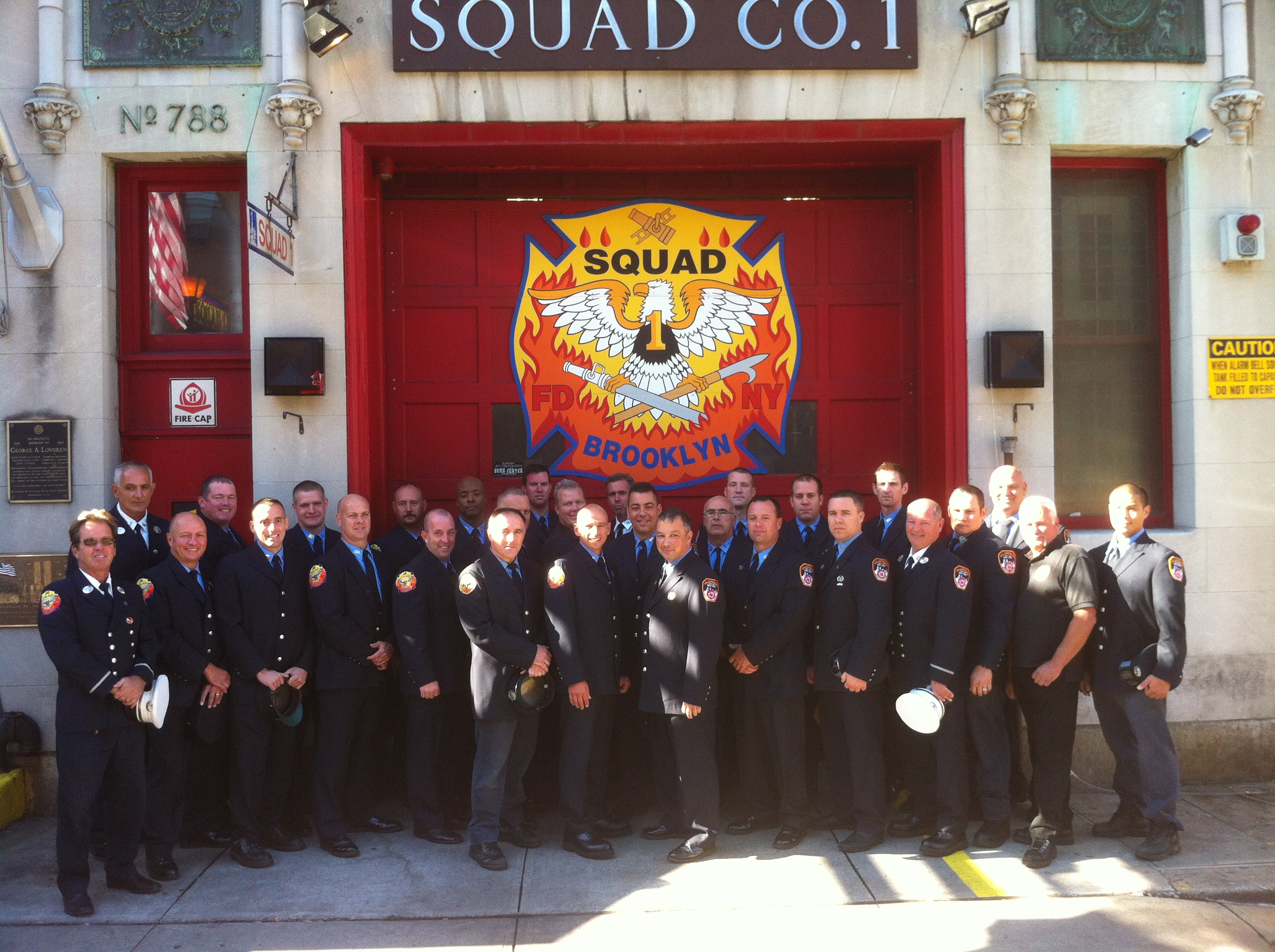
As in the ten previous years, I’ll be at the Squad 1 firehouse in Park Slope, Brooklyn and as in the ten previous years, there will be moments of silence. Have you ever gone to your local firehouse and asked any of the firefighters why 9-11 is “still such a big deal”? Or your local police department? Have you ever asked someone who is currently in the military why 9-11 is “still such a big deal”?
One thing I can assure you is there isn’t a single New Yorker who doesn’t look up and flinch a bit when a jet flies overhead on a cloudless blue-sky day – especially on 9-11. Same goes for the Washington, DC and Shanksville, PA areas. I guess it’s “still such a big deal.”
Have you ever asked someone whose loved one was murdered on that day why it is “still such a big deal”?
Perhaps it is something you should consider doing. I know you think you’ll hear people bemoaning their losses – and you will – but most of the people will tell you what they’ve learned about themselves and others and the world around them near and far.
Not forgetting is not about being maudlin or holding on to the past; history is studied and analyzed so that we hopefully don’t make the same mistakes in the future. On a personal level, Penelope Trunk wrote a nice piece on how to live without regret in a time when it often seems as if towers are teetering all around us.
9-11 has significantly altered the way first responders address catastrophic events; yet mistakes are still being made and bureaucracies still need to catch up with present day realities such as how cooperation on local, state, and national levels is actually a good thing or how having far better communication systems that don’t degrade during all-hell-is-breaking-loose events is not bad either.
In what is now the eleventh year since 9-11, I’m still learning about how I’ve been affected. Remembering 9-11 is more than remembering loss and grief; it is thinking how to live a better life and be a better person, neighbor, friend, parent, spouse. It is Penelope Trunk making a compelling case for not living a life of regrets.
9-11 reminds me of the work I need to perform on myself because there are 3,000 more Angels in Heaven than I anticipated and I’m just not sure there’s room for me. It is and always will be a sacred day.
There are an inordinate number of fluff pieces “teaching” those in transition out of the military (or already out) how to use LinkedIn for job search. This won’t be one of them.
While it would be great if all military personnel had a LinkedIn profile from the time they entered service (not sure if the respective branches would like this idea), at the very least each of you should consider creating one the moment you put in your EAS papers. It doesn’t have to include the grandiose, tell-all content the “career experts” instruct you to have (I’d include a link or two but there are so many and as far as I can tell they all say the same things) but should include some key “identifiers” of your time in such as:
The recruiting station that put you in the service (if you can remember that);
Your first “Camp” – as well as all subsequent “Camps”;
Your “Tours”;
Your chains of commands (you’ll see why in a bit):
Navy: Command, Fleet… (don’t expect too many folks to say they’re part of SEAL Team 6 – remember, it doesn’t exist)
Your duties and “accomplishments” for each (I’d consider not mentioning “kills” anywhere in your LinkedIn profile – those who haven’t served or those who don’t have a solid connection to the military can be a bit squeamish);
Honors and Awards: List all of your military accolades.
Summary: This is the toughest part to write because many of you are transitioning out – and you really don’t know what you want to do. That’s fine…do you really believe many new college grads feel any different about their career direction? Yet what you do know – and I’ve spoken to enough folks who have transitioned out to know this is true – is whether:
You like to work with your hands;
You like to work with your mind;
You prefer Coke over Pepsi (use other comparisons too);
You prefer Ford over Toyota;
You buy or use a specific company’s products or services (make a list)
We’ll return to this list a bit later on – but you’ll see why I’m suggesting such a granular detailing of your service (just a pre-FYI, the Summary might be the hardest part of your LinkedIn profile to write).
The bottom line about LinkedIn is that it’s a tool to help you connect to people who are either like you (or were once like you) and who might be able to connect you to people who are perhaps more like you – and finally to people who are in direct position to help you get into a company – or profession – of your liking.
Let’s see how someone transitioning out of the Army might use LinkedIn to make a BIG difference in their career search:
(incidentally, noticed I didn’t write “post military”; for some, the process of “finding” a career might actually lead you BACK into the military)
My Dad’s an original soldier in 10th Mountain Division – I’m talking WWII original (you might see why I’m using the Army as an example). The 10th is the most deployed Division in the Army – so let’s use them as an example of how you might use LinkedIn to develop your network.
Once you’ve logged in to your LinkedIn account:
Click on “Advanced” next to the People box (upper right side).
In the “Keywords” box, type in: “10th mountain division” OR “tenth mountain division” (with the quotes – notice how only OR is capitalized)
Click on “Search”
1,173 people on LinkedIn with some connection to the Mountaineers…
You’re probably thinking, “I don’t know these people – and even more, why they would they want to help me?”
Because you share a common bond; do not for a single second think otherwise. My soon-to-be-89-year-old Dad goes weekly to the VA hospital near Ft. Hamilton for treatment and when he sees other – and far younger – 10th soldiers, the walls come down and they’re yapping away like they’ve known each other for eons. Shoot – he’ll even sing the original – and highly bawdy – 10th song to these folks. They all laugh and talk about battles, guns, life…
So start looking at the profiles of the 1,173 people and note the ones who were part of the 10th but also live in an area where you might want to live…for example, Chicago, IL:
Go back to the results page (the page with the 1,173 results);
In the “Postal Code” box, type in “60607” and select “50 Miles” in the “Within” box
17 people live in a 50 mile radius around Chicago…
Connect with all of these folks and ask them if they wouldn’t mind being Mentors to a transitioning Mountaineer. When you do connect, I know you’ll play “20 Questions” with each person – and gain a very solid networking buddy.
Just so you don’t think I’m being biased to one branch over another, run the same top search if you’re a Marine:
Click on “Advanced” next to the People box (upper right side).
In the “Keywords” box, type in: (marines OR USMC) AND (“Force Recon” OR “Force Reconnaissance”) (with the quotes and parentheses; notice how OR and AND are capitalized)
Click on “Search”
347 people on LinkedIn with some connection to Marines who were part of Force Recon…
If you’re in the USAF:
Click on “Advanced” next to the People box (upper right side).
In the “Keywords” box, type in USAF OR “air force” (with the quotes; notice how OR is capitalized)
Click on “Search”
344,408people on LinkedIn with some connection to the USAF… (notice how I only used the name of the branch and not a specific Wing; if you’re in another branch, do the same for your branch – this is a HUGE network for you to work)
If you’re in the USCG:
Click on “Advanced” next to the People box (upper right side).
In the “Keywords” box, type in uscg OR “coast guard” (with the quotes – notice how OR is capitalized)
Click on “Search”
46,096 people on LinkedIn with some connection to the USCG…
Finally if you’re in the Navy:
Click on “Advanced” next to the People box (upper right side).
In the “Keywords” box, type in: “us navy” OR “u.s. navy” (with the quotes – notice how OR is capitalized)
Click on “Search”
203,477 people on LinkedIn with some connection to the Navy…
I hope you see how adding – or subtracting – keywords from an Advanced search allows you to really fine tune your results; if you’re in the Navy but want to go into Sales in Des Moines, IA, using LinkedIn is just as “simple” as:
Click on “Advanced” next to the People box (upper right side).
In the “Keywords” box, type in: “us navy” OR “u.s. navy” (with the quotes – notice how OR is capitalized)
In the Title box, type in “sales” (without quotes) and select “Current or past” in the drop down box below it;
In the Postal Code box, type in 50301 and select “50 mi” in the Within box;
Click on “Search”
There are 23 people who live near Des Moines, IA, have had a job in sales, and who served in the Navy…sure it’s just 23 but it’s 23 people who might end up being the conduit to your next job.
Remember all those details I wrote about at the top? You can fine tune any search you perform with keywords such as where you did your Basic Training, a Platoon where you had the most “success”, or a carrier you served on. LinkedIn is all about finding common bonds with people who can – and are willing – to help you in your career search…and your service is a bond that few citizens will ever have. So be prepared to compare your experience in your branch of service using these items when you actually have that phone call with someone who might have had the same experience as you; it’s the ultimate form of networking – talking with a fellow American who like you served this country.
That’s enough for now; I’ll be writing a few follow-up posts including what to really say when you connect with someone using the LinkedIn messaging feature and how to focus in on specific careers (because I know many folks transitioning out of the military really don’t know what they want from a career). Likewise, there’ll be a post solely focused on writing a Summary.
Since I’m sure there are questions out there – from those in the USAF, CG, USMC and Navy, comment here and I’ll answer them… Finally, my network is your network; if you really do know what you want to do – and you actually have target companies, I’ll do my best to connect you to some of those companies.
Yeah, I did make that offer…but you served so I feel obliged to help.




 The Recruiting Inferno